DRM-Protected LMS for Coaching Institutes India 2026: Tested

Founder & Lead Developer, Codingclave · 200+ projects since 2017
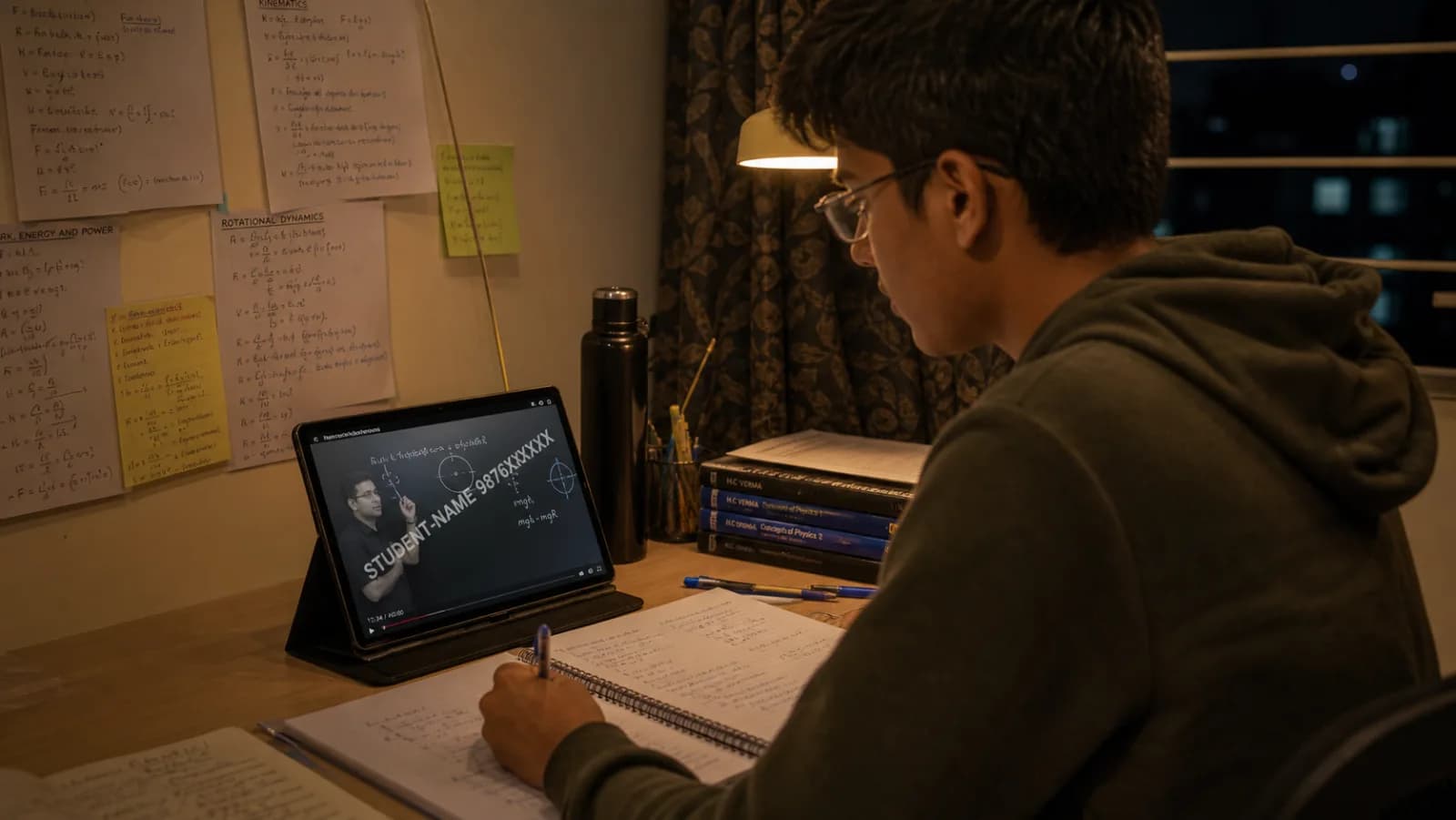
A DRM-protected LMS for an Indian coaching institute costs ₹19,999 to ₹99,999 a year on SaaS (Classplus and Graphy; Learnyst is $149 a month) or ₹3L to ₹25L to build custom, and the video DRM itself runs $149 to $4,999 a year on VdoCipher's October 2026 list plans depending on how much your students stream. The reason to pay it: in June 2026 Delhi Police arrested three men who used a Telegram bot to pull more than 2,400 lectures out of a UPSC platform serving 4 lakh students, with about ₹35 lakh in traced sales (The420.in, 1 July 2026).
I'm Ashish Sharma, founder of Codingclave in Lucknow. We have been building software since 2017, more than 200 projects so far, and LMS platforms for coaching institutes are a regular part of that work. This guide covers what DRM actually blocks, what it costs at each institute size, how VdoCipher compares with Gumlet, TPStreams, Mux and Bunny on October 2026 pricing, and when a ₹20,000 a year SaaS plan is the right answer instead of a custom build.
What does a DRM-protected LMS cost for a coaching institute in India?
| Institute size | Sensible path | What you pay | Time to launch |
|---|---|---|---|
| 50-300 students, 1-2 subjects | Classplus or Graphy with built-in DRM | ₹19,999-₹49,999/yr plus 5-10% transaction fee on Graphy | 3-7 days |
| 300-1,500 students | Ready-made LMS (ours is ₹49,999 one-time or ₹4,999/mo) plus VdoCipher Pro | ₹50K-₹1.5L setup plus about ₹13K-₹15K/mo video | 2-3 weeks |
| 1,500-5,000 students, own branding | Custom LMS plus VdoCipher or TPStreams plus one mobile app | ₹3L-₹8L upfront plus ₹25K-₹75K/mo | 8-12 weeks |
| 5,000-15,000 students | Custom LMS, iOS plus Android apps, multi-DRM | ₹8L-₹15L plus ₹50K-₹2L/mo | 12-18 weeks |
| 15,000 plus students | Custom platform, TV apps, live classes, enterprise video contract | ₹13L-₹25L plus ₹2L-₹6L/mo | 18-26 weeks |
SaaS prices are list prices on the vendors' pages as of October 2026; custom ranges are what our quotes land at, and they move with scope. Video delivery is the line that scales with students, so I show the math for it later in this guide.
Why do coaching institutes in India need DRM in 2026?
The June 2026 Delhi Police case is the clearest recent example. According to The420.in's report of 1 July 2026, a UPSC coaching platform with more than 400,000 students and 2,500 videos found on 10 March that its lectures were being sold through a Telegram bot. The accused used fake messaging IDs, virtual numbers registered in Ethiopia and Bangladesh, and anonymous wallets. Three men aged 21 to 28 from Aligarh and Faridabad were arrested between 5 and 8 June by the Cyber Police Station of Delhi Police's North district, and police traced transactions of around ₹35 lakh through bank accounts and wallets. Police also said the group may have pirated material from several other institutes.
That is one gang, one platform, one quarter. The institutes I speak to in Lucknow, Kanpur and Patna describe the same pattern at smaller scale: a ₹40,000 to ₹85,000 course appears on Telegram within weeks at 5 to 10 percent of the price, and the seller is usually a current student with a shared login.
What DRM blocks and what it does not
| Threat | Plain MP4 or YouTube unlisted | DRM-protected LMS (Widevine L1 plus FairPlay) |
|---|---|---|
| Right-click, save video | Works | Blocked, no file exists on the device |
| Browser extension or IDM download | Works | Blocked, stream is encrypted and key is per session |
| Telegram download bots | Work | Fail, bot cannot obtain a licence |
| Screen recording on iPhone or iPad | Works | Black frame (FairPlay) |
| Screen recording on Widevine L1 Android | Works | Blocked inside the native app |
| Screen recording on Widevine L3 Android | Works | Possible, but limited to SD and watermarked |
| Sharing one login with friends | Easy | Concurrent session limits and device binding |
| Phone camera pointed at a screen | Possible | Possible, low quality, watermark identifies the student |
DRM does not make piracy impossible. It makes piracy slow, ugly and traceable, which is enough to kill the resale market because nobody pays ₹3,500 for a shaky camera recording with another student's phone number across it.
How does video DRM work on Widevine, FairPlay and PlayReady?
Three DRM systems cover the devices Indian students use. The video is encrypted once at upload; the player requests a licence for each playback session; the licence is issued only if your LMS backend confirms the student is logged in, enrolled and within device limits.
| DRM system | Owner | Where it plays | Notes for coaching |
|---|---|---|---|
| Widevine | Chrome, Firefox, Edge, Opera on Windows, macOS, Linux and ChromeOS; all Android phones and tablets; Android TV and Fire TV | Covers the majority of Indian students; security level L1 or L3 depends on the phone | |
| FairPlay Streaming | Apple | Safari on iOS, iPadOS and macOS; Apple TV; native iOS apps | Required for any iPhone or iPad user |
| PlayReady | Microsoft | Edge on Windows; Xbox; many Samsung and LG smart TVs; Android TV and Fire TV also support it | Only matters if you ship a smart TV app |
Device coverage above is from castLabs' public DRM comparison page (checked October 2026). Every provider I compare below bundles Widevine plus FairPlay; PlayReady is a line item you add when TV apps become a real request.
Widevine L1 vs L3 in one table
| Widevine L1 | Widevine L3 | |
|---|---|---|
| Where decryption happens | Inside the Trusted Execution Environment, decoding too | In software, no TEE |
| Resolution content owners allow | HD and 4K | Usually standard definition |
| Screen capture in a native app | Can be blocked completely | Cannot be reliably blocked |
| Typical devices | Most mid-range and premium phones, smart TVs, streaming sticks | Budget phones, many cheap tablets, older TVs, rooted or modified devices |
Source: VdoCipher's Widevine guide, which states that on L1 "TEE does all the video decryption, decoding, and processing" and that L1 devices can block screen capture inside mobile apps. A student can check their own phone with the free DRM Info app on Google Play; it shows the Widevine level in the first screen.
Can students still screen-record DRM-protected videos?
This is the question every coaching founder asks me, so here is the honest answer by platform.
iPhone and iPad. FairPlay blocks screen recording and AirPlay mirroring of protected content. The recording file shows a black frame with audio. There is nothing extra to configure; it comes with FairPlay.
Android with Widevine L1. Inside a native app (React Native, Flutter or Kotlin) with the provider's SDK, the secure surface prevents capture. Screen recorders, scrcpy and screenshot shortcuts all return black. VdoCipher adds Google Play Integrity checks to reject emulators and rooted phones.
Android with Widevine L3. The player cannot stop a recorder, so the defence changes: serve 480p only, overlay a moving watermark with the student's name and phone, and let the student know it is there. A recording still exists, but it names its source. You decide in your LMS whether L3 devices get access at all. Blocking them is cleaner for a ₹85,000 JEE course; allowing them keeps your Tier-2 and Tier-3 students on ₹8,000 phones.
Desktop browsers. Chrome, Firefox and Edge on Windows run Widevine L3 by default, so browser playback is the weakest link on every provider. Treat the web player as L3: SD cap and watermark. Safari on macOS uses FairPlay and blocks capture.
Camera on a screen. No DRM stops this. Watermark, SD cap and a takedown process are the only answers, and together they work because a 480p phone recording with a visible name is worth almost nothing on Telegram.
Which SaaS LMS platforms include DRM for Indian coaching?
If you have under 1,500 students and no special features in mind, start here. Prices are from the vendors' pricing pages or listings as of October 2026.
| Platform | Price (Oct 2026) | DRM included | Branded apps | Transaction fee | Fits |
|---|---|---|---|---|---|
| Classplus | From ₹19,999/yr, up to about ₹50,000/yr by services (SoftwareSuggest listing, updated 21 April 2026) | Yes, encrypted video in the app | Branded Android app and website | Pricing by sales, not public | Single-teacher to mid-size coaching that wants fastest launch |
| Graphy | Launch ₹24,999/yr, Grow ₹49,999/yr, Rise ₹99,999/yr (graphy.com/pricing) | Yes on all plans | Branded Android app on all plans; iOS is a paid add-on | 10%, 7.5%, 5% per sale or ₹10, whichever is higher | Course creators and institutes selling online |
| Learnyst | $149, $249 and $799 per month (learnyst.com/pricing, USD page) | Yes on all; L1 DRM only on Business | Branded Android from Premium; Android plus iOS on Business, annual commitment | 0% | Institutes that want zero transaction fee and strong DRM |
| Teachmint | Not published; demo-based quotes | Yes in the app | Branded app | Not public | Schools and coaching already using Teachmint classroom tools |
| Our ready LMS | ₹49,999 one-time or ₹4,999/mo | Hosting billed separately by VdoCipher, Gumlet or TPStreams | Optional, quoted | 0% from us; gateway MDR only | Institutes that want their own code and data without a full custom build |
Two things to check before you sign. First, the transaction fee: at ₹50L a year of course sales, Graphy's Launch plan costs ₹24,999 plus ₹5L in fees, which is why Learnyst's 0 percent and a flat $149 a month (about ₹1.57L a year) win above roughly ₹13L of annual sales on the Launch plan. Second, who owns the student list and the video files if you leave. Most SaaS contracts let you export students; none let you export DRM-encrypted videos in playable form, so keep your masters.
Our best LMS software in India roundup covers ten of these platforms feature by feature if you want the longer comparison.
VdoCipher vs Gumlet vs TPStreams vs Mux vs Bunny: which video DRM provider should you use?
If you build or own your LMS, you pick the video layer separately. These are the list prices on each provider's pricing page as of October 2026. I convert at about ₹88 to the dollar; adjust for the day's rate.
| Provider | Entry DRM plan | Scale plan | Bandwidth overage | DRM included | Dynamic watermark | India angle |
|---|---|---|---|---|---|---|
| VdoCipher | Starter $149/yr, 1 TB, 100 GB storage | Premium $4,999/yr, 50 TB, 2 TB storage; Pro $1,599/yr, 15 TB, 1 TB storage | $0.11/GB down to $0.07/GB; storage $0.75/GB | Widevine plus FairPlay on every paid plan | Yes, all plans | India-founded, Google Widevine direct partner, Play Integrity checks, Moodle and WordPress plugins; SDKs and APIs from Value ($399/yr) up; offline download from Express ($699/yr) |
| Gumlet | Growth $19/mo plus DRM add-on $99/mo, 3 TB/mo | Business $99/mo plus $99 DRM, 3 TB/mo, 15,000 storage minutes | $0.10/GB (Growth), $0.06/GB (Business) | Add-on $99/mo, included on Enterprise | Business plan only | India-founded, cheapest certified DRM under 3 TB a month |
| TPStreams | Start $150/mo, 750 GB delivery, 150 GB storage, 55,000 DRM licences | Growth $1,350/mo, 26 TB; Scale $4,050/mo, 90 TB | $0.020-$0.032/GB; DRM licence $0.0006-$0.0017 | Yes on all plans | Yes | India-built (Testpress team), DRM licences bundled into every plan |
| Mux | Pay as you go, 100,000 free delivery minutes/mo, then $0.001/min; DRM $100/mo plus $0.003 per licence | Scale $500/mo for $1,000 credit | Per minute, not per GB | Add-on, requires Plus or Premium quality tier, which adds per-minute encoding charges | Build your own | US-based, best developer experience, priciest at coaching scale |
| Bunny Stream plus Media Cage | Storage $0.01/GB, CDN from $0.005/GB; Asia and Oceania CDN tier $0.03/GB | Same, volume tier available | Pay as you go | Multi-DRM through Media Cage, enterprise pricing not published | Build your own | Cheapest raw delivery; DRM needs a sales conversation and your own integration |
| Cloudflare Stream | $5 per 1,000 minutes stored, $1 per 1,000 minutes delivered | Same | Per minute | Not in pricing docs | No | Fine for free content and marketing; not for paid lectures |
The monthly video bill for a real institute
List prices are hard to compare because VdoCipher sells annual bandwidth, Gumlet sells monthly bandwidth and Mux sells minutes. Here is the same workload on each. Assumptions: 2,000 active students, each watching 10 hours a month at 720p, which is about 0.5 GB an hour, so 10 TB a month and 120 TB a year, from a 100-hour library. The second row is a 300-student institute at 1.5 TB a month. These are my calculations from the October 2026 list prices above; enterprise quotes come in lower.
| Provider | 300 students, 1.5 TB/mo | 2,000 students, 10 TB/mo | How it adds up at 10 TB |
|---|---|---|---|
| VdoCipher | about $153/mo (₹13.5K): Pro $1,599/yr for 15 TB, plus 3 TB overage at $0.08/GB | about $825/mo (₹73K) | Premium $4,999/yr for 50 TB plus 70 TB at $0.07/GB = $9,899/yr |
| Gumlet | $118/mo (₹10.4K): Growth $19 plus $99 DRM, 3 TB included | about $618/mo (₹54K) | Business $99 plus DRM $99 plus 7 TB at $0.06/GB |
| TPStreams | about $174/mo (₹15K): Start $150 plus 750 GB overage at $0.032/GB | about $562/mo (₹49K) | Pro $450 for 6 TB plus 4 TB at $0.028/GB |
| Mux | about $235/mo (₹21K): 180,000 minutes less 100,000 free, DRM access, licences | about $1,460/mo (₹1.28L) | 1.1M billable minutes at $0.001, $100 DRM access, 80,000 licences at $0.003, storage; Plus-tier encoding of the library is extra |
| Bunny Stream | about $45/mo (₹4K) delivery only | about $300/mo (₹26K) delivery only | 10 TB at $0.03/GB Asia CDN, plus Media Cage DRM at an unpublished enterprise price |
| Cloudflare Stream | about $180/mo (₹16K), no DRM | about $1,230/mo (₹1.08L), no DRM | 1.2M minutes at $1 per 1,000 plus storage |
What this table says: under 3 TB a month Gumlet with the DRM add-on is the cheapest certified DRM you can buy; from 3 TB to about 30 TB a month TPStreams and VdoCipher are within 20 percent of each other and VdoCipher wins on features (Play Integrity in its Android, React Native and Flutter SDKs, a piracy identification tool, offline download, CMS plugins); past 30 TB a month everyone negotiates, and Bunny's raw delivery price becomes tempting if you have a developer who can own the Media Cage integration. Mux is the right choice when video quality and developer tooling matter more than the bill, which is rarely true for coaching.
Should you buy a SaaS LMS or build a custom DRM-protected LMS?
The decision is about students, price per course and features, in that order.
Under 300 paying students. Buy. Classplus or Graphy, launch this week, spend your money on content and marketing. Our guide on digital marketing for coaching institutes will do more for revenue than any custom feature at this stage.
300 to 1,500 students. Buy a platform you own but did not build from scratch. Our ready-made LMS product at ₹49,999 one-time covers courses, video lessons, live classes, quizzes, certificates and Razorpay payments; you add VdoCipher or Gumlet for the video layer and keep your student data. This is also where Learnyst's 0 percent transaction fee starts beating Graphy's 5 to 10 percent.
1,500 to 5,000 students, or any size with a course priced above ₹15,000. Custom becomes worth it once SaaS fees pass roughly ₹1L a month or you need something the platform cannot do: your own mock test engine on a proprietary question bank, a doubt-solver, parent dashboards, regional language UI, or L1-only enforcement rules. The full cost breakdown is in our LMS development cost in India guide; the summary table is below.
5,000 plus students. Custom, with an enterprise video contract. At 50 TB a month, list prices stop applying and the difference between a negotiated VdoCipher, TPStreams or Bunny deal is several lakh a year.
What a custom DRM-protected LMS build includes and costs
| Component | Upfront (our 2026 quotes) | Monthly |
|---|---|---|
| Web LMS plus admin and faculty content tools (Next.js, Node or Python, Postgres) | ₹2L-₹5L | Hosting ₹8K-₹25K |
| Video DRM integration (VdoCipher, TPStreams or Gumlet SDK, licence auth, watermark, device limits) | ₹50K-₹1.5L | Provider bill from the table above |
| Razorpay one-time plus subscription payments, UPI Autopay | ₹40K-₹80K | Gateway MDR only, compare in our Razorpay vs PayU vs Cashfree post |
| Android plus iOS apps (React Native or Flutter) with secure playback | ₹2L-₹4L | Apple $99/yr, Google $25 once |
| Live classes (100ms: $0.004 per participant minute for conferencing, $0.0012 per viewer minute for interactive live streaming, 10,000 free minutes a month, October 2026 pricing) | ₹1L-₹2L | ₹20K-₹1.5L depending on hours |
| Mock test engine with your question bank | ₹1L-₹2L | none |
| AI doubt-solver on your notes and past papers (OpenAI or Claude API) | ₹1.5L-₹3L | ₹15K-₹65K API usage |
| Smart TV apps (Android TV, Samsung Tizen, LG webOS with PlayReady) | ₹2L-₹4L | none |
| WhatsApp lesson links and parent updates via WATI | ₹30K-₹60K | Meta conversation charges |
A mid-size build (web, admin, DRM, payments, one mobile app) lands at ₹3L-₹8L and 8-12 weeks. Add both apps, live classes and the mock test engine and you are at ₹8L-₹15L and 12-18 weeks. TV apps and the doubt-solver push a large institute to ₹13L-₹25L and 18-26 weeks. If you only need the app side priced, see how much a mobile app costs in India.
How do you stop login sharing and Telegram leaks beyond DRM?
DRM is one layer. The institutes that actually stop leaks stack six.
- Concurrent session limit. One active playback per account, with a forced logout on the older device. This alone ends the "one login, twelve friends" pattern.
- Device binding. Allow two registered devices per student per year, with a self-service swap limit. Make the third device require a call to the office.
- Visible dynamic watermark. Name and last four digits of the phone number, moving every few seconds, on every frame, including in the web player. VdoCipher, Gumlet (Business plan) and TPStreams all support it. This is what turns a leak into evidence.
- L3 and browser policy. Decide whether L3 phones and desktop browsers get SD only, or get nothing. Write it into your terms and tell students at enrolment.
- Integrity checks. Reject rooted phones, emulators and modified APKs. VdoCipher's Android, React Native and Flutter SDKs integrate Play Integrity and block emulators by default (vdocipher.com/playintegrity); on a custom player you wire them yourself.
- Takedown and legal process. Monitor Telegram for your brand name weekly. When a leak appears, read the watermark, suspend the account, and send a notice to dmca@telegram.org with the channel link and proof of ownership. For organised resale, file with the state cyber cell citing Section 63 of the Copyright Act 1957 (six months to three years imprisonment and a fine of ₹50,000 to ₹2 lakh for criminal infringement) and Section 65A (circumventing a technological protection measure, up to two years). The June 2026 Delhi case was handled by the Cyber Police Station of Delhi Police's North district and went from discovery on 10 March to arrests on 5 and 8 June.
What we see in coaching LMS projects
A few patterns from the LMS work we have done out of Lucknow since 2017, offered as observations rather than numbers I can prove to you:
- The first leak almost always comes from a shared login, not a hack. Concurrent session limits do more in week one than any DRM upgrade.
- Founders overestimate how many students are on L3 phones. Before deciding on L1-only, ship the player with analytics for a month and read the device report; the share is usually smaller than feared in JEE and NEET batches and larger in SSC and state exam batches.
- Watermarks change behaviour. Students who see their own name on the video stop forwarding it to the class WhatsApp group. The deterrent works before any legal step.
- The move from SaaS to custom is triggered by a feature, not by piracy. The common one is a mock test engine on the institute's own question bank; the second is parent reporting. Piracy is the reason founders give, features are the reason they sign.
- Budget 15 to 20 percent of the build cost per year for maintenance, SDK updates and OS changes. iOS and Android change their media APIs often enough that a player left alone for 18 months breaks.
If you want a second opinion on a quote you already have, I'm happy to read it; we are a 5-20 person team and I still scope coaching projects personally. Our Google rating is 4.9 from 76 reviews and we are a Top Rated agency on Upwork, which you can check before you call.
How long does it take to launch a DRM-protected LMS?
| Scope | Timeline | Typical cost |
|---|---|---|
| SaaS (Classplus, Graphy, Learnyst) with your branding and first courses | 3-7 days | ₹19,999-₹99,999/yr plus fees; Learnyst from $149/mo |
| Ready-made LMS plus VdoCipher or Gumlet, your domain, Razorpay | 2-3 weeks | ₹50K-₹1.5L plus video bill |
| Custom web LMS plus DRM plus one mobile app | 8-12 weeks | ₹3L-₹8L |
| Custom plus iOS and Android plus live classes plus mock tests | 12-18 weeks | ₹8L-₹15L |
| Full platform with TV apps, AI doubt-solver, multi-DRM | 18-26 weeks | ₹13L-₹25L |
| Migrating an existing library of 100-500 hours into DRM hosting | 1-2 weeks, in parallel | Encoding is included by VdoCipher, Gumlet, TPStreams and Bunny; Mux charges per input minute on the tiers DRM requires |
Apple App Store review adds one to two weeks to any schedule that includes an iOS app, so start the developer account on day one.
Get your DRM-protected LMS scoped
If your lectures are on Telegram, or you are paying a SaaS platform ₹1L a month for features you cannot change, send me your student count, course price and the three features you wish you had. I will tell you whether SaaS, our ready-made LMS or a custom build is the honest answer, and what the video bill will be at your scale.
WhatsApp Ashish for free LMS scoping
About the author
Ashish Sharma is the founder of Codingclave, a Lucknow software company founded in 2017 that has shipped more than 200 projects, holds a 4.9 Google rating from 76 reviews and is a Top Rated agency on Upwork. He scopes LMS and coaching platform projects personally. Reach him on LinkedIn, Upwork or WhatsApp.
Related reading:
Frequently asked questions
A DRM-protected LMS is a learning platform whose videos are encrypted and can only be decrypted by an authorised player on an authorised device, using Google Widevine, Apple FairPlay or Microsoft PlayReady. Without it, a paid lecture is an MP4 file that any browser extension or Telegram bot can download and resell. In June 2026 Delhi Police arrested three men who pulled over 2,400 videos out of a UPSC platform with 4 lakh students using a Telegram bot, with about ₹35 lakh of sales traced (The420.in, 1 July 2026). If you charge ₹15,000 or more for a course, DRM is the minimum protection.
Three bands. SaaS with DRM built in: Classplus from ₹19,999 a year, Graphy from ₹24,999 a year, Learnyst from $149 a month. Our ready-made LMS is ₹49,999 one-time or ₹4,999 a month with DRM hosting billed by the video provider. Custom LMS with VdoCipher integration and one mobile app: ₹3L-₹8L upfront plus ₹15K-₹75K a month for video delivery. Fully custom with iOS, Android, TV apps and live classes: ₹13L-₹25L. The video DRM itself runs $149 to $4,999 a year on VdoCipher list plans depending on bandwidth.
On iPhone and iPad, FairPlay blocks screen recording; the recording shows a black frame. On Android phones with Widevine L1 (hardware decryption in the Trusted Execution Environment), the player can block capture completely inside a native app. On Widevine L3 phones (software-only DRM, common on budget devices), recording is technically possible, so the player limits L3 to standard definition and overlays a moving watermark with the student's name or phone number. Students can check their own phone with the free DRM Info app on Play Store.
For most Indian coaching institutes VdoCipher is still the default: Widevine plus FairPlay on every paid plan, dynamic watermark, Play Integrity checks, plans from $149 a year for 1 TB to $4,999 a year for 50 TB (October 2026 list). Gumlet is the cheapest way to get certified DRM at small scale: Growth plan $19 a month plus a $99 a month DRM add-on for 3 TB of bandwidth. TPStreams is India-built and bundles DRM licences into monthly plans from $150. Mux is excellent infrastructure but DRM costs $100 a month plus $0.003 per licence on top of per-minute delivery, so it is the most expensive at coaching scale.
No. DRM stops file downloads, browser extensions, Telegram download bots and screen recording on L1 and iOS devices. It does not stop a phone camera pointed at a laptop screen. That is why every serious coaching LMS pairs DRM with a visible watermark showing the student's identity, concurrent session limits, device binding and a takedown process. The goal is to make piracy slow, low quality and traceable to a named student, which collapses the resale market.
Widevine L1 decrypts and decodes video inside the device's Trusted Execution Environment, so the decrypted frames never reach the normal operating system; it allows HD playback and lets native apps block screen capture. L3 decrypts in software, is limited to standard definition by most content owners, and cannot reliably block recording. For coaching, the practical choice is whether to serve L3 phones at all. Blocking them removes a slice of your budget-phone students; allowing them at 480p with a watermark keeps reach while limiting the damage. Learnyst, for example, sells L1-level DRM only on its $799 a month Business plan, which shows how vendors price the difference.
No. YouTube does not offer DRM to uploaders and unlisted links can be shared freely; Google Drive files can be downloaded or mirrored with one click. If your paid lectures live on either, assume they are already on Telegram. Moving them into a DRM-protected host like VdoCipher, Gumlet or TPStreams and serving them only through your LMS is the first fix, and it can be done in under a week for a small library.
File a complaint with the cyber cell (the Cyber Police Station of Delhi Police's North district handled the June 2026 UPSC case), citing Section 63 of the Copyright Act 1957 (criminal infringement, six months to three years imprisonment and a fine of ₹50,000 to ₹2 lakh) and Section 65A (circumventing technological protection measures such as DRM, up to two years). In parallel, send takedown notices to Telegram at dmca@telegram.org with the channel links and proof of ownership. Watermarked leaks make this far easier because the leaked frame names the student account.