ABDM Compliance Hospital India 2026: M1/M2/M3 and HEM 2.0

Founder & Lead Developer, Codingclave · 200+ projects since 2017
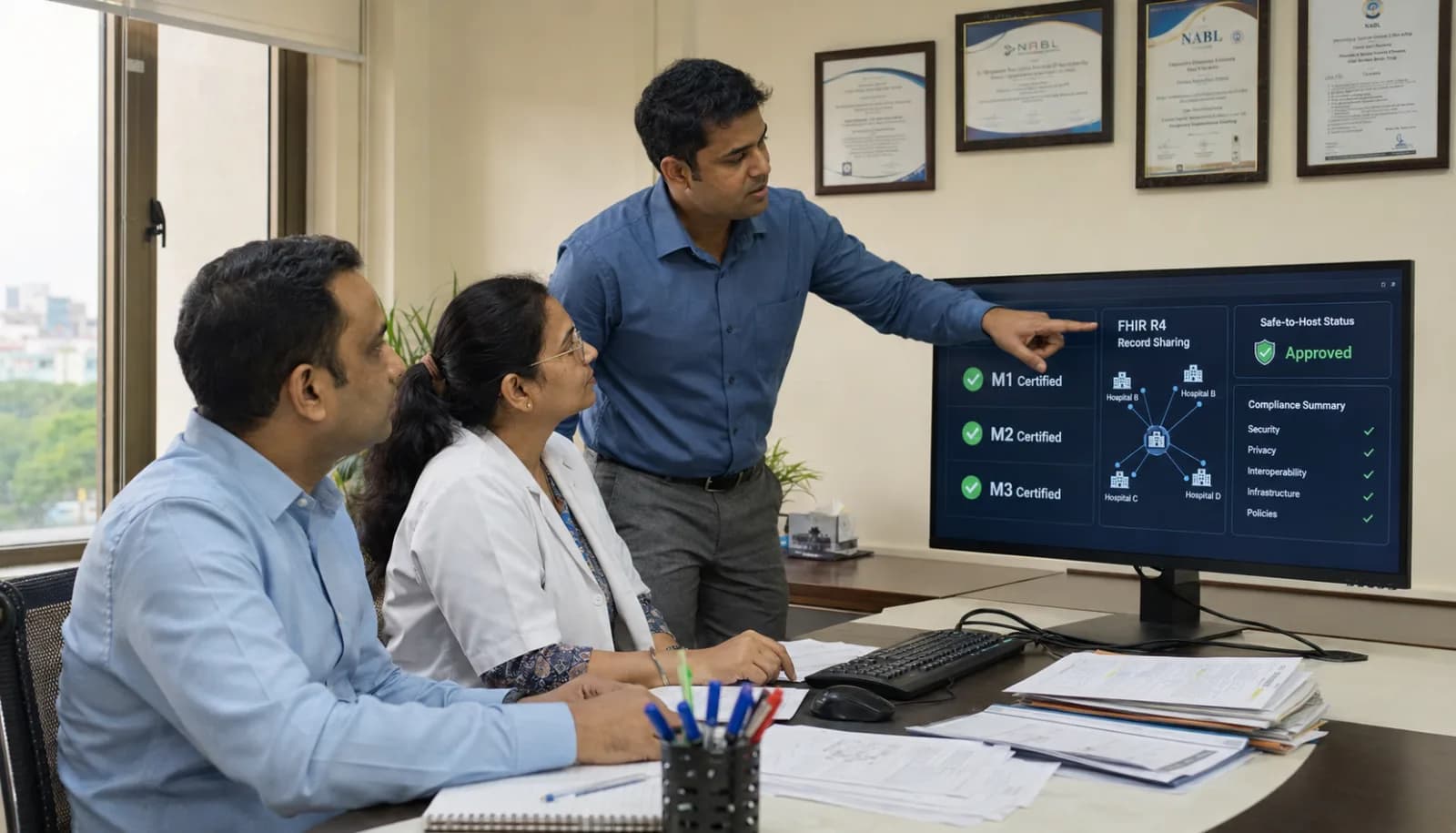
ABDM Compliance Hospital India 2026: The Definitive Guide
If you're running an Indian hospital in 2026, ABDM compliance is no longer optional. The National Health Authority (NHA) has rolled out mandatory certification milestones (M1, M2, M3) for hospital management software. Uttar Pradesh mandated HEM 2.0 compliance from January 2026. Bihar issued direct ABDM compliance directives to all AB-PMJAY hospitals in early 2026. State schemes (MJPJAY Maharashtra, CMCHIS Tamil Nadu, Arogya Karnataka, Aarogyasri AP/Telangana, Chiranjeevi Rajasthan) all leverage ABDM infrastructure.
The cost of non-compliance is brutal: UP alone suspended payments to ~100 hospitals and de-empanelled another ~100 in early 2026 for HEM 2.0 + ABDM violations. Each de-empanelled hospital loses ₹15L-₹5Cr/year in PM-JAY scheme revenue.
I'm Ashish Sharma, founder of Codingclave. We've shipped 18+ hospital management software deployments + 6 ABDM-integrated builds for Indian hospitals since 2020. This is the definitive 2026 guide — covering NHA certification, state-specific requirements, real costs, timelines, and the exact technical architecture you need.
WhatsApp me for free ABDM compliance audit → — 30-min discovery call, honest recommendations.
TL;DR — ABDM Compliance Roadmap for Indian Hospitals
| Your Starting Point | Recommended Path | Cost | Timeline |
|---|---|---|---|
| Paper/Excel-based hospital | Full custom HMS + ABDM native build | ₹14L-₹40L | 8-12 months |
| Basic SaaS HMS (no ABDM) | Upgrade to ABDM-ready SaaS or migrate to custom | ₹3L-₹15L | 4-7 months |
| Existing custom HMS (no ABDM) | ABDM bolt-on integration | ₹6L-₹15L | 8-12 weeks |
| Existing custom HMS (partial ABDM) | Complete M2/M3 + Safe-to-Host audit | ₹3L-₹8L | 8-12 weeks |
| Multi-location hospital chain | Phased ABDM rollout across locations | ₹30L-₹2Cr | 9-18 months |
| Specialty hospital (cardiac/oncology) | Custom HMS + ABDM + specialty workflows | ₹18L-₹50L | 6-9 months |
What ABDM Actually Is (Plain English)
The Ayushman Bharat Digital Mission (ABDM) is India's national digital health infrastructure — think of it as the "UPI of healthcare." Run by the National Health Authority (NHA), it standardizes how Indian hospitals, clinics, labs, pharmacies, and patients share health information securely.
Five core building blocks:
1. ABHA (Ayushman Bharat Health Account)
Every Indian citizen gets a 14-digit unique health ID (free, optional but increasingly default). ABHA links all your health records across hospitals — discharge summaries, prescriptions, lab reports, radiology images. Patient grants consent each time records are shared.
2. HIE-CM (Health Information Exchange — Consent Manager)
The consent layer. When Dr. A at Hospital X needs Patient P's records from Hospital Y, HIE-CM mediates: Patient P receives a consent request on their ABHA app, approves it, and an encrypted token authorizes the record transfer. Privacy-by-design — patient is always in control.
3. HIP (Health Information Provider)
If your hospital generates patient records, you're a HIP. Your HMS must serve those records on-demand to other authorized systems via ABDM APIs, in FHIR R4 format (international healthcare data standard), encrypted, with consent verification.
4. HIU (Health Information User)
If your hospital consumes patient records from other systems (e.g., your doctor pulls a patient's previous prescription from their old hospital), you're a HIU. Your HMS must request records via ABDM APIs and process the FHIR R4 responses.
5. HFR + HPR (Health Facility Registry + Healthcare Professional Registry)
National registries. Your hospital registers on HFR (gets a unique HFR ID). Each doctor at your hospital registers on HPR (gets unique HPR ID linked to their qualifications). These IDs flow through all ABDM transactions.
Sample ABDM patient journey:
- Patient walks into your hospital
- Your HMS verifies their ABHA ID (M1 functionality)
- With consent, pulls their history from previous hospital (M3 / HIU functionality)
- Doctor diagnoses, prescribes, orders tests
- Your HMS creates discharge summary in FHIR R4 format
- Records linked to patient's ABHA + available for future doctors with consent (M2 / HIP functionality)
- Patient accesses everything via their ABHA app
This is the standard. To support this, your HMS needs M1, M2, M3 certifications.
M1, M2, M3 Certification — Deep Dive
Milestone 1: ABHA Creation + Verification (Foundation)
Duration: 2-4 weeks for an experienced team
What your HMS proves:
- Can create new ABHA IDs for walk-in patients (via Aadhaar OTP, mobile OTP, or email)
- Can verify existing ABHA IDs against NHA's central database
- Stores ABHA-patient linkage in your local database
- Implements ABHA QR code scanning (patients can show their ABHA QR)
APIs to integrate:
- ABHA Number creation (
/v3/profile/account) - ABHA Address creation
- ABHA verification (Aadhaar/mobile/email/QR)
- Profile fetching
NHA sandbox tests: Standardized patient registration scenarios (Aadhaar OTP, mobile OTP, fallback workflows, error handling).
Real-world impact after M1: Your hospital can accept ABHA-linked patients + start building ABHA database. Cannot yet share records — that's M2.
Milestone 2: HIP (Health Information Provider) — The Hard One
Duration: 4-12 weeks depending on data maturity
What your HMS proves:
- Can convert existing patient records (lab reports, prescriptions, discharge summaries, OPD notes) into FHIR R4 format
- Implements care context creation (associates records with patient's ABHA)
- Handles patient discovery requests (when other systems search for patient records)
- Implements consent verification (only shares records with valid consent token)
- Securely serves records via encrypted channel
- Implements audit logging (every record share is logged)
APIs to integrate:
- Care context creation
- Patient discovery
- Consent verification
- Health Information sharing
NHA sandbox tests: Full record-sharing workflows — consent grant, encrypted transfer, FHIR R4 validation, audit trail.
Why M2 is the hardest:
- FHIR R4 is complex (international healthcare data standard with hundreds of resource types — Patient, Observation, MedicationRequest, DiagnosticReport, etc.)
- Your existing data must be mapped to FHIR R4 resources
- Encryption + key management requires careful implementation
- Consent flow integration with HIE-CM
Real-world impact after M2: Your hospital can accept ABHA-linked patients AND share records with other hospitals in the ABDM network. PM-JAY empanelment becomes feasible.
Milestone 3: HIU (Health Information User) — The Easy Win After M2
Duration: 2-4 weeks (shares infrastructure with M2)
What your HMS proves:
- Can request patient records from other HIPs via ABDM
- Handles consent request flows (patient approves on their ABHA app)
- Processes FHIR R4 responses
- Displays imported records in your HMS UI for doctors
APIs to integrate:
- Consent request
- Health Information request
- Response processing
Real-world impact after M3: Your doctors can pull patient's history from previous hospitals (with consent). Better clinical decisions, fewer duplicate tests, better patient outcomes.
Milestone 4 (Newer, Optional)
Advanced features: Dr Locker (doctors keep their own credentials portable), advanced consent flows (auto-renewing consent for chronic patients), pharmacy + lab interoperability.
Mandatory Additional Requirements
Beyond M1/M2/M3:
- Safe-to-Host Web Security Certificate — OWASP-10 audit by STQC/CERT-IN empanelled agency (₹50K-₹2L, 2-4 weeks)
- HFR registration — register your hospital on national registry
- HPR registration — every doctor registers individually
- DPDP Act 2023 compliance — patient data privacy
- NHA final approval — bundle all certificates + Safe-to-Host + WASA final report + deployment details, submit to NHA, get production access (2-3 weeks)
State-Specific Requirements (Beyond National ABDM)
ABDM is national but each state administers PM-JAY through its own State Health Agency with additional state-specific compliance:
| State | State Scheme | State Authority | State Portal | Special Requirements |
|---|---|---|---|---|
| Uttar Pradesh | AB-PMJAY | SACHIS | SACHIS portal | HEM 2.0 (Jan 2026 mandatory) |
| Maharashtra | MJPJAY (Mahatma Jyotirao Phule Jan Arogya) | SAHB | MJPJAY portal | Geo-tagging + quarterly audits |
| Tamil Nadu | CMCHIS (Chief Minister's Comprehensive Health Insurance Scheme) | TNAJBKS | CMCHIS portal | Tamil-language support recommended |
| Karnataka | Arogya Karnataka + AB-PMJAY | SAST | SAST portal | Kannada UI recommended |
| Andhra Pradesh + Telangana | Aarogyasri | Aarogyasri Trust | Aarogyasri portal | Telugu UI recommended |
| Gujarat | MA Yojana (Mukhyamantri Amrutam) | MA Trust | MA portal | Gujarati UI recommended |
| Rajasthan | Chiranjeevi Yojana | RGHS | Chiranjeevi portal | State-mandatory cost ceilings |
| Madhya Pradesh | AB-MMJAY | MMJAA | MMJAA portal | Hindi UI required |
| Bihar | AB-PMJAY (Swasthya Suraksha Samiti) | BSSS | BSSS portal | Early 2026 ABDM directive |
| Kerala | KASP + Karunya | KASP Trust | KASP portal | Strict on transparency |
| West Bengal | Swasthya Sathi | WB Health | Swasthya Sathi portal | Bengali UI recommended |
| Delhi NCR | AB-PMJAY (Delhi Arogya Kosh) | Delhi Health | Delhi portal | Standard ABDM |
| Punjab/Haryana | AB-SSBY + variants | State agencies | State portals | Punjabi/Hindi UI |
| Odisha | BSKY (Biju Swasthya Kalyan Yojana) | OSHA | BSKY portal | Odia UI recommended |
| Chhattisgarh | AB-MSBY | CGMSC | State portal | Hindi UI required |
| Jharkhand | Mukhyamantri Jan Arogya Yojana | JSACS | State portal | Hindi UI required |
State guides for deep details:
- HEM 2.0 Compliance UP Hospital 2026
- MJPJAY Compliance Maharashtra Hospital 2026
- CMCHIS Compliance Tamil Nadu Hospital 2026
- Arogya Karnataka Compliance Hospital 2026
- Aarogyasri Compliance AP/Telangana Hospital 2026
(More state guides linked at the bottom of this article.)
Real Costs: ABDM Compliance Pricing Breakdown 2026
Path 1: Pre-Built ABDM-Compliant SaaS HMS
Vendors: Medixcel, MocDoc, Adrine, Halemind, Insta Health
Cost: ₹2L-₹15L/year subscription (₹15K-₹1.25L/month) depending on hospital size
Timeline: 4-8 weeks to deploy
Pros:
- Fastest path to ABDM compliance
- Vendor handles M1/M2/M3 certification (you inherit it)
- Predictable monthly cost
- Vendor handles ABDM API updates
Cons:
- Limited customization
- Per-bed or per-user pricing scales up at large hospitals
- Vendor-dependent for any custom workflows
- Standard SaaS features only
Best for: Hospitals under 100 beds, standard workflows, want fastest deployment.
Path 2: Third-Party ABDM API Middleware (Existing HMS)
Approach: Your existing HMS connects to ABDM via API middleware provider
Cost: ₹1L-₹10L one-time + ₹15K-₹50K/month middleware fees
Timeline: 8-16 weeks
Pros:
- Keep existing HMS investment
- Middleware handles ABDM complexity
- Mid-price between SaaS and custom
Cons:
- Two-vendor dependency (your HMS vendor + middleware vendor)
- Performance overhead (middleware adds latency)
- Limited control over API behavior
Best for: Hospitals with existing custom HMS that don't want full rebuild.
Path 3: Custom HMS Built ABDM-Native
Approach: Build hospital management software from scratch with ABDM compliance native to the architecture
Cost: ₹14L-₹40L upfront + ₹50K-₹3L/year maintenance
Timeline: 12-24 weeks
Pros:
- Full feature control + customization
- No per-user/per-bed scaling fees
- Own all data + relationships
- ABDM built-in, not bolted-on (better performance + UX)
- Can integrate specialty workflows + medical devices
Cons:
- Higher upfront investment
- Need IT team or vendor relationship for maintenance
- Longer time-to-launch
Best for: Hospitals 200+ beds, specialty hospitals, hospital chains, hospitals wanting long-term ownership.
Path 4: ABDM Bolt-On to Existing Custom HMS
Approach: Add M1/M2/M3 ABDM compliance to your existing custom HMS
Cost: ₹6L-₹15L bolt-on
Timeline: 8-12 weeks
Pros:
- Cheapest ABDM-compliant path if you already have custom HMS
- Preserves existing investment
- Faster than rebuilding
Cons:
- Existing HMS quality determines integration cleanliness
- Architecture decisions in original HMS may need refactoring
Best for: Hospitals with existing custom HMS that need ABDM added.
Hidden Costs Most Vendors Don't Mention
- Safe-to-Host security audit — ₹50K-₹2L (mandatory before NHA approval)
- HFR registration — free but requires submission of hospital documents
- HPR registration — each doctor self-registers (free)
- NHA application fees — currently nominal/free
- Data migration from old system — ₹50K-₹3L depending on data volume
- Staff training — ₹50K-₹2L (3-5 day training program for hospital staff)
- Ongoing maintenance — ABDM specs evolve; expect ₹50K-₹3L/year maintenance to stay current
Timeline: Hospital to Full ABDM Production-Ready
Standard Path (Hospital with Existing Digital HMS)
| Week | Activity |
|---|---|
| Week 1-2 | NHA sandbox registration + initial API integration |
| Week 3-6 | M1 implementation + sandbox testing + functional approval |
| Week 7-18 | M2 implementation (FHIR R4 + consent + record sharing) + sandbox testing |
| Week 19-22 | M3 implementation (record consumption) + sandbox testing |
| Week 23-26 | Safe-to-Host security audit (parallel to M3) |
| Week 27-28 | NHA final approval submission + production access grant |
| Week 29-32 | Production deployment + staff training |
Total: 6-8 months for hospital with existing infrastructure.
Accelerated Path (Hospitals Working with Codingclave)
We've built ABDM-ready architecture templates that compress this to 3-5 months for hospitals with existing digital HMS. Cost: ₹6L-₹15L bolt-on.
For hospitals starting from paper/Excel: 8-12 months full custom HMS + ABDM build. Cost: ₹14L-₹40L.
How to Pick Your ABDM Compliance Path
Decision Framework
Q1: Are you on paper/Excel, basic SaaS, or custom HMS?
- Paper/Excel → Build custom HMS with ABDM native (Path 3)
- Basic SaaS without ABDM → Migrate to ABDM-compliant SaaS (Path 1) OR custom (Path 3)
- Custom HMS without ABDM → Bolt-on ABDM (Path 4)
- Custom HMS with partial ABDM → Complete M2/M3 + Safe-to-Host
Q2: What's your hospital size?
- Under 50 beds → SaaS usually wins on cost (Path 1)
- 50-200 beds → Bolt-on if existing custom, else SaaS or custom (Path 1/3/4)
- 200-500 beds → Custom usually wins on TCO (Path 3)
- 500+ beds / multi-location → Custom mandatory (Path 3)
Q3: Are you specialty hospital?
- General hospital → Any path works
- Cardiac, oncology, fertility, eye, etc. → Custom (Path 3) — specialty workflows need flexibility
Q4: What's your 5-year strategic horizon?
- Stable, no expansion → SaaS works (predictable monthly cost)
- Planning expansion (chain, telemedicine, research) → Custom for flexibility + ownership
Q5: What's your upfront budget?
- Under ₹6L → SaaS or basic bolt-on
- ₹6L-₹15L → Standard custom bolt-on or premium SaaS
- ₹15L-₹40L → Full custom HMS + ABDM
- ₹40L+ → Enterprise custom + multi-location + specialty modules
What's New in ABDM Compliance in 2026
1. UP HEM 2.0 Mandate (January 2026)
UP became first state to enforce HEM 2.0 module on SACHIS portal. 200+ hospitals had payments suspended. Other states (Maharashtra, Karnataka, Tamil Nadu) expected to follow with similar state modules in 2026-2027.
2. Bihar ABDM Direct Mandate (Early 2026)
Bihar Swasthya Suraksha Samiti CEO issued direct compliance directive to all AB-PMJAY empanelled hospitals — integrate with ABDM or face de-empanelment.
3. FHIR R4 Becomes Mandatory Format
Earlier ABDM accepted multiple record formats. 2026: FHIR R4 only for all M2 record sharing. Older HMS systems using HL7 v2 or CDA need conversion layer.
4. AI-Assisted Clinical Documentation Becoming Default
Major HMS systems now ship AI documentation features (transcribe doctor-patient conversation to structured EMR notes). Reduces doctor documentation time 60-70%. Built on OpenAI Whisper + GPT-4o with medical fine-tuning.
5. WhatsApp Integration Standard for Patient Communication
Indian hospitals integrate WATI or AiSensy for: appointment reminders, lab report delivery (via secure WhatsApp link), prescription refill alerts, post-discharge follow-ups. Patient response rate 5-8x higher than SMS/email.
6. UPI Autopay for OPD Package Subscriptions
Hospitals offering monthly health check-up packages (₹500-₹2,000/month — periodic tests + consultations) use UPI Autopay for auto-debit. RBI clarification 2025 made this reliable.
7. ABHA App Adoption Crossed 50 Crore
Patients increasingly arrive at hospitals with ABHA already linked. Hospitals without ABDM compliance can't accept these patients' digital records — losing competitive advantage.
8. AI Voice Agents for 24x7 Appointment Booking
24x7 AI voice agents booking appointments via phone replace evening + weekend reception. Indian-language support via Sarvam + ElevenLabs. See our AI Voice Agent Development guide.
Real Stories — Indian Hospitals That Got ABDM-Compliant
Story 1: 240-Bed Indore Hospital — From Patchwork to Unified ABDM-Compliant HMS
Indore hospital with 240 beds + 3 satellite clinics. Was on multi-vendor patchwork (Insta Health for HMS, separate vendors for pharmacy/lab/billing) costing ₹35L/year combined. No ABDM compliance — losing PM-JAY scheme revenue.
We built unified custom HMS in 28 weeks for ₹26L:
- All standard hospital modules
- ABDM M1/M2/M3 native architecture
- PM-JAY workflow integration
- WhatsApp patient portal
- AI-assisted clinical documentation
5-year outcome:
- Replaced patchwork SaaS at ₹35L/year → custom at ₹46L total over 5 years
- Saved ~₹1.4Cr over 5 years + unified data + ABDM compliance unlocked PM-JAY revenue
- PM-JAY scheme revenue: ₹0 → ₹85L/year additional after empanelment
Story 2: Specialty Cardiac Hospital Hyderabad — Custom for Unique Workflows + ABDM
60-bed cardiac specialty hospital. Standard SaaS HMS didn't support cath lab scheduling, cardiac registry, custom procedure risk scoring. Also missing ABDM compliance.
We built custom HMS + ABDM in 22 weeks for ₹18L:
- All standard hospital modules
- Cath lab scheduling
- Cardiac registry (research-grade data export)
- Custom procedure risk calculator
- ABDM M1/M2/M3 + Safe-to-Host certified
- Direct integration with Philips IntelliVue monitors
Outcome:
- Replaced ₹6L/year SaaS that lacked specialty features
- Cardiac registry generated 3 published research papers in year 2
- Empanelled in PM-JAY post-ABDM = ₹40L/year additional revenue
- Specialty-specific workflows reduced documentation time 50%
Story 3: 80-Bed UP Hospital — Beat HEM 2.0 Deadline With ABDM Bolt-On
Mid-size UP hospital with existing custom HMS but no ABDM compliance. Heading into HEM 2.0 enforcement (January 2026) at risk of de-empanelment.
We added ABDM bolt-on in 11 weeks for ₹9.5L:
- M1 ABHA creation + verification
- M2 HIP + HIE-CM integration (FHIR R4)
- M3 HIU (request external records)
- Safe-to-Host security audit
- SACHIS portal documentation help
- Staff training (5 days)
Outcome:
- HEM 2.0 + ABDM compliant before January 2026 deadline
- PM-JAY payments continued uninterrupted (avoided ₹65L/year revenue loss)
- ROI break-even: month 2 (single avoided suspension covered the cost)
How Codingclave Builds ABDM-Compliant Hospital Software
We've shipped 18+ HMS deployments + 6 ABDM-integrated builds since 2020. Standard delivery:
| Scope | Timeline | Cost |
|---|---|---|
| ABDM bolt-on for existing custom HMS (M1+M2+M3+Safe-to-Host) | 8-12 weeks | ₹6L-₹15L |
| Mid-size hospital HMS + ABDM native (50-150 beds) | 16-24 weeks | ₹14L-₹25L |
| Large hospital HMS + ABDM (200-500 beds) | 24-36 weeks | ₹25L-₹50L |
| Specialty hospital HMS + ABDM (cardiac/oncology/eye) | 18-30 weeks | ₹18L-₹40L |
| Enterprise hospital chain HMS + multi-location ABDM | 30-50 weeks | ₹40L-₹2Cr |
| State scheme compliance add-on (HEM 2.0, MJPJAY, etc.) | +2-4 weeks | +₹1L-₹4L |
| AI clinical documentation add-on | +6-10 weeks | +₹3L-₹6L |
Every delivery includes: ABDM M1/M2/M3 certification support, NHA sandbox setup, Safe-to-Host security audit coordination (with CERT-IN empanelled partners), HFR + HPR registration help, DPDP Act 2023 compliance, WhatsApp patient communication, UPI + insurance billing integration, role-based access, monitoring + analytics, training for hospital staff.
Get ABDM-Compliant Before Your State Mandate Hits
If your hospital isn't ABDM-compliant yet — whether you're in UP (HEM 2.0 already enforced), Maharashtra/Tamil Nadu/Karnataka (state mandates expected 2026-2027), or Bihar (early 2026 directive) — every month of delay risks de-empanelment from ₹15L-₹5Cr/year scheme revenue.
Talk to me directly for a free 30-minute ABDM compliance audit + honest recommendation (including telling you to stay on SaaS if that's right for you).
WhatsApp Ashish for free ABDM audit →
Or schedule a 30-minute call →
About the Author
Ashish Sharma is the founder of Codingclave, a Top Rated Upwork agency that has shipped 18+ HMS deployments + 6 ABDM-integrated builds for Indian hospitals since 2020 — small clinics to 500-bed multi-location chains across UP, Maharashtra, Karnataka, Tamil Nadu, AP/Telangana. He works directly with hospital administrators + medical directors on ABDM compliance + state scheme empanelment. Reach him on LinkedIn, Upwork, or WhatsApp.
Related deep guides:
- ABDM M1/M2/M3 Certification Guide India 2026
- ABDM Integration Cost India 2026
- HEM 2.0 Compliance UP Hospital 2026
- PM-JAY Empanelment Software India 2026
- ABHA Integration Hospital Software India 2026
- Best ABDM-Compliant Hospital Management Software India 2026
- Hospital Management Software Cost India 2026
- Healthcare Software Development India 2026
- AI Voice Agent Development India 2026
- WhatsApp API Pricing India 2026
State-specific compliance guides:
- MJPJAY Maharashtra Hospital 2026
- CMCHIS Tamil Nadu Hospital 2026
- Arogya Karnataka Hospital 2026
- Aarogyasri AP/Telangana Hospital 2026
- MA Yojana Gujarat Hospital 2026
- Chiranjeevi Yojana Rajasthan Hospital 2026
- AB-MMJAY Madhya Pradesh Hospital 2026
- BSSS Bihar Hospital 2026
- KASP Kerala Hospital 2026
- Swasthya Sathi West Bengal Hospital 2026
- Delhi NCR ABDM Hospital 2026
- Punjab/Haryana ABDM Hospital 2026
- Odisha/Chhattisgarh/Jharkhand ABDM Hospital 2026
Frequently asked questions
ABDM (Ayushman Bharat Digital Mission) is India's national digital health infrastructure run by the National Health Authority (NHA). ABDM compliance means your hospital's software can: (1) Create + verify ABHA (Ayushman Bharat Health Account) IDs for patients; (2) Share patient health records securely via FHIR R4 format with consent; (3) Pull patient records from other hospitals in the ABDM network. Mandatory for: (1) AB-PMJAY empanelment (₹15L-₹5Cr/year scheme revenue per hospital); (2) State scheme empanelment (MJPJAY Maharashtra, CMCHIS Tamil Nadu, Arogya Karnataka, etc.); (3) UP HEM 2.0 + SACHIS compliance from January 2026; (4) Bihar Swasthya Suraksha Samiti directive early 2026. National rolling deadlines through 2026-2027 are making ABDM mandatory for all licensed hospitals.
M1/M2/M3 are NHA's progressive certification milestones for hospital management software (per-software, not per-facility). M1 (2-4 weeks, foundation): ABHA creation + verification at patient registration. Implements ABHA APIs, passes NHA functional testing for identity workflows. M2 (4-12 weeks, most technical): Health Information Provider (HIP) functionality — when patients or other systems request health records via ABDM, your HMS serves them encrypted in FHIR R4 format with consent management. Includes care context creation, patient discovery, consent flows. M3 (2-4 weeks after M2): Health Information User (HIU) — your HMS can request + consume records from other HIPs in the ABDM network. A doctor in your hospital can pull patient's records from previous hospital. M4 (newer, optional): advanced features like Dr Locker, advanced consent flows, pharmacy/lab interoperability. Total realistic timeline M1+M2+M3 production-certified: 3-6 months for hospital with existing digital infrastructure.
HEM 2.0 (Hospital Empanelment Module 2.0) is Uttar Pradesh's state-specific compliance framework for AB-PMJAY empanelled hospitals, mandated from January 2026. ABDM is national (NHA-run); HEM 2.0 is UP-state-administered (SACHIS portal). HEM 2.0 requires: re-uploading hospital details on SACHIS portal, physical verification, geo-tagged photos, periodic quality reviews + ongoing compliance. Hospitals need BOTH ABDM (national NHA certification of HMS) AND HEM 2.0 (state-administered hospital documentation). Other states have equivalent state modules — Maharashtra MJPJAY portal, Tamil Nadu CMCHIS portal, Karnataka SAST portal, etc. UP enforcement is harshest in early 2026 — 200+ hospitals had payments suspended or de-empanelled for HEM 2.0 non-compliance. See our [HEM 2.0 Compliance UP Guide](/guides/hem-2-0-compliance-uttar-pradesh-hospital-2026) for the UP-specific deep-dive.
Three real cost paths. (1) Pre-built ABDM-compliant SaaS HMS (Medixcel, MocDoc, Adrine): ₹2L-₹15L/year subscription, fastest deploy (4-8 weeks), generic functionality. (2) Third-party ABDM API integration middleware on existing HMS: ₹1L-₹10L one-time + ₹15K-₹50K/month, 8-16 weeks, adds layer to your current software. (3) Custom HMS with ABDM-native build from scratch: ₹14L-₹40L, 12-24 weeks, full ownership + customization. (4) Bolt-on ABDM compliance to existing custom HMS: ₹6L-₹15L, 8-12 weeks. Plus mandatory CERT-IN Safe-to-Host security certificate: ₹50K-₹2L additional + 2-4 weeks. See our [ABDM Integration Cost India 2026 guide](/guides/abdm-integration-cost-india-2026) for the detailed cost breakdown.
Five core ABDM API systems: (1) ABHA APIs — create + verify Ayushman Bharat Health Account IDs via Aadhaar/mobile/email; (2) HIE-CM (Health Information Exchange — Consent Manager) — patient consent flows for sharing health records, encrypted token exchange; (3) HIP (Health Information Provider) APIs — your HMS serves health records to other systems with consent, returns in FHIR R4 format; (4) HIU (Health Information User) APIs — your HMS requests records from other HIPs, processes responses; (5) HFR (Health Facility Registry) + HPR (Healthcare Professional Registry) — register your hospital + each doctor on national registries. All APIs documented at sandbox.abdm.gov.in. Production access granted only after NHA approval of M1/M2/M3 milestones + Safe-to-Host security audit.
Realistic timelines based on starting point. (1) Hospital with existing digital HMS (just missing ABDM): 3-6 months — sandbox registration (2-4 weeks) + M1 (2-4 weeks) + M2 (4-12 weeks) + M3 (2-4 weeks) + Safe-to-Host security audit (2-4 weeks) + NHA final approval (2-3 weeks). (2) Hospital with basic SaaS HMS (needs ABDM-ready upgrade or migration): 4-7 months. (3) Hospital running paper/Excel (full HMS + ABDM build needed): 8-12 months. (4) Multi-location hospital chain: 9-18 months for phased rollout. Implementation rollout adds 4-12 weeks (data migration, staff training, parallel run, cutover). Most hospitals we work with phase implementation: Phase 1 OPD + ABDM M1 first, Phase 2 IPD + M2, Phase 3 M3 + specialty modules.
ABDM is national framework — single ABDM compliance covers ABHA + record sharing across all states. But each state has its own SCHEME-specific portal + empanelment process: UP (SACHIS + HEM 2.0), Maharashtra (SAHB + MJPJAY portal), Tamil Nadu (TNAJBKS + CMCHIS portal), Karnataka (SAST + Arogya Karnataka portal), Andhra Pradesh + Telangana (Aarogyasri portal), Gujarat (MA Yojana portal), Rajasthan (Chiranjeevi Yojana portal), Madhya Pradesh (AB-MMJAY portal), Bihar (BSSS portal), Kerala (KASP portal), West Bengal (Swasthya Sathi portal). Hospitals need ABDM certification (national) PLUS state empanelment documentation (state-specific). Custom HMS built ABDM-native simplifies multi-state expansion. Most state schemes leverage ABDM record-sharing infrastructure but add state-specific paperwork + audits.
Safe-to-Host is mandatory web application security audit certificate before ABDM production access. Conducted by STQC (Standardisation Testing and Quality Certification) or CERT-IN (Indian Computer Emergency Response Team) empanelled security testing agencies. Covers: OWASP-10 web application vulnerabilities, authentication + session management, input validation, encryption (in-transit + at-rest), API security, audit logging, data privacy (DPDP Act 2023 compliance). Process: hospital + HMS vendor engages CERT-IN empanelled agency, undergoes security testing (2-4 weeks), receives Safe-to-Host certificate (valid 1-2 years, renewable). Cost: ₹50K-₹2L depending on application size + auditor. Required for NHA final approval of M1/M2/M3 milestones. Without Safe-to-Host, ABDM production access is denied regardless of milestone certification.