ABDM Compliance Delhi NCR Hospital 2026: Multi-State Guide

Founder & Lead Developer, Codingclave · 200+ projects since 2017
ABDM Compliance Delhi NCR Hospital 2026: The Multi-State Playbook
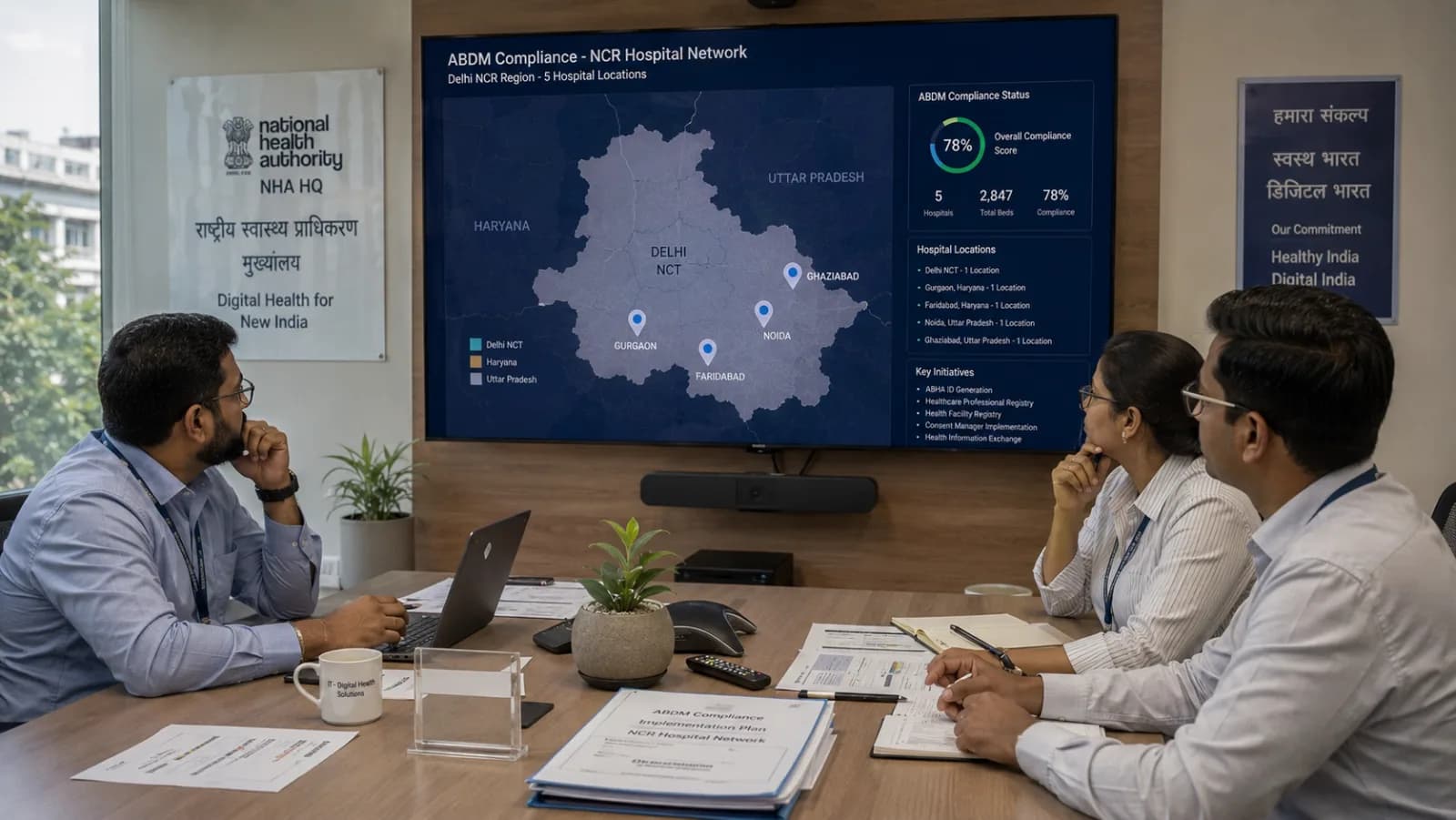
If you run a hospital anywhere in Delhi NCR, 2025-2026 changed your compliance calculus fundamentally. Delhi joined AB-PMJAY on 5 April 2025 as the 35th State/UT, with a doubled ₹10L/family/year cover (₹5L NHA + ₹5L Delhi government top-up) benefiting ~6.54 lakh families across 1,961 packages and 27 specialties. NCR's three other zones — Haryana (Gurgaon, Faridabad) under Chirayu Haryana + AB-PMJAY, and UP NCR (Noida, Ghaziabad) under SACHIS HEM 2.0 — each have their own state portal and audit pattern. Stacked on top: national ABDM M1/M2/M3 certification is now formally linked to AB-PMJAY empanelment retention.
Nationally, 36,229 hospitals are empanelled under AB-PMJAY as of 28 February 2026 (19,483 public + 16,746 private). UP has already suspended ~200 hospitals over compliance gaps. Bihar issued a direct ABDM directive in early 2026. NCR is the next obvious enforcement focus — NHA HQ is in Delhi, AIIMS New Delhi is a reference ABDM implementation, and Delhi's fresh April-2025 empanelment baseline is ABDM-aware from day one.
I'm Ashish Sharma, founder of Codingclave. We're based in Lucknow — a 6-hour drive or 1-hour flight to Delhi, which means NCR is one of the most accessible regions we serve. We deliver ABDM + state-scheme compliance for Delhi NCR hospitals through remote-first development plus scheduled on-ground visits for discovery, audit prep, go-live, and training.
WhatsApp me directly for a free 30-min audit →
TL;DR — Delhi NCR Hospital Compliance Path
| Your Hospital Status | Compliance Path | Cost (INR) | Timeline |
|---|---|---|---|
| Empanelled, HMS already ABDM-certified | State portal refresh + audit prep only | ₹50K – ₹2L | 2–4 weeks |
| Empanelled, custom HMS without ABDM | ABDM M1/M2/M3 bolt-on + Safe-to-Host + state docs | ₹7L – ₹18L | 8–14 weeks |
| Empanelled, basic SaaS without ABDM | Migrate to ABDM SaaS OR custom + state docs | ₹3L – ₹25L | 4–7 months |
| Empanelled, paper/Excel | Full custom HMS + ABDM-native + state portals | ₹20L – ₹45L | 9–14 months |
| Multi-state NCR chain (Delhi + Gurgaon + Noida) | All of above + cross-state coordination | Add 20–35% | Add 4–8 weeks |
| Large NCR hospital (150–500 bed) | ABDM enterprise + multi-package state workflows | ₹35L – ₹95L | 16–30 weeks |
| Enterprise/multi-location (Medanta/Max-tier) | Full enterprise ABDM + group portal mgmt | ₹60L – ₹3Cr | 24–50 weeks |
Multi-Jurisdiction Matrix — The Critical NCR Difference
Most state-scheme guides cover one regulator. NCR forces you to deal with three state administrations plus national NHA simultaneously. Get this matrix wrong and you can be ABDM-compliant on paper but locked out of cashless claims in two of your three NCR locations.
| Zone | Cities | State Scheme | State Portal | National Layer |
|---|---|---|---|---|
| Delhi NCT | New Delhi, all Delhi districts | AB-PMJAY (since 5 Apr 2025) + Delhi Arogya Kosh + Ayushman Vay Vandana | Delhi State Health Agency portal + nha.gov.in | ABDM M1/M2/M3 + HFR/HPR + Safe-to-Host |
| Haryana NCR | Gurgaon/Gurugram, Faridabad | AB-PMJAY + Chirayu Haryana (extended 2025 — paid tiers ₹4K-₹5K/yr for higher income) | ayushmanbharat.haryana.gov.in | ABDM M1/M2/M3 + HFR/HPR + Safe-to-Host |
| UP NCR | Noida, Greater Noida, Ghaziabad | AB-PMJAY via SACHIS HEM 2.0 (mandatory Jan 2026) | sachisup.in / pmjay.up.gov.in | ABDM M1/M2/M3 + HFR/HPR + Safe-to-Host |
Practical implications:
- Single-location hospital in Delhi NCT — Delhi SHA portal + ABDM. Cleanest path.
- Single-location Gurgaon or Faridabad hospital — Haryana state portal + ABDM. Watch the IMA Haryana payment-delay situation (April 2026).
- Single-location Noida or Ghaziabad hospital — UP SACHIS HEM 2.0 + ABDM. See our HEM 2.0 UP guide for SACHIS-specific workflow.
- NCR hospital chain (e.g., Delhi + Gurgaon + Noida units) — all three state portals + ABDM + unified HMS that can switch claim format by location. This is where most NCR compliance projects spend their budget. Cross-state patient movement is extremely high in NCR, making M3 HIU (external record pull) functionally critical — a patient registered at your Noida unit may have records at a Delhi unit that need pulling under consent.
What ABDM + State Compliance Actually Requires (NCR Hospital Owner Guide)
The administrative stack across NCR is consistent on the national layer, varies on the state layer. Here's the full picture:
1. National ABDM Certification (NHA — Same for All NCR Hospitals)
Your hospital management software must hold all three certifications:
- M1 (Health Information Exchange) — ABHA verification at OPD/IPD registration, linking patient records to ABHA ID
- M2 (Health Information Provider, HIP) — push FHIR R4 records (discharge summaries, lab reports, prescriptions, OP/IP encounters) to ABHA-linked PHRs
- M3 (Health Information User, HIU) — request and pull external patient records into your HMS with patient consent
Plus the hospital registered on HFR (Health Facility Registry), doctors on HPR (Healthcare Professional Registry), and a CERT-IN / STQC Safe-to-Host security audit on the HMS environment. DPDP Act 2023 data-protection compliance throughout (consent, breach reporting, data minimisation).
2. State Portal Documentation (Zone-Specific)
Delhi NCT: Empanelment documentation on the Delhi State Health Agency portal — hospital registration certificate, bed strength, department list, doctor roster with HPR IDs, NABH/NABL certs where claimed, infrastructure photos, equipment inventory, recent ABHA-linked transactions as ABDM-use evidence.
Haryana (Gurgaon, Faridabad): ayushmanbharat.haryana.gov.in empanelment + Chirayu Haryana scheme integration if applicable. Similar document set; eligibility-criteria page specifies bed/specialist/infrastructure minimums. Payment-tracking is currently a pain point (April 2026 IMA Haryana letter) — keep claim documentation immaculate to minimise hold risk.
UP NCR (Noida, Ghaziabad): SACHIS portal HEM 2.0 documentation — geo-tagged hospital photos, license/registration, doctor list with HPR IDs, ABDM transaction proof, physical verification. See HEM 2.0 UP guide for the full SACHIS playbook.
3. Physical Verification
Each state agency conducts on-ground audits independently. Delhi SHA, Haryana ABHPA, and UP SACHIS all visit empanelled hospitals — sometimes surprise, sometimes scheduled. They check that documentation matches reality, ABDM transactions are visible in your production HMS (not just screenshots), and quality compliance is real.
4. Ongoing Operating Compliance
Quarterly self-audit submissions on relevant state portals, license/NABH/NABL/fire-NOC renewals, patient grievance resolution, DPDP Act 2023 compliance, claim accuracy + outcome reporting.
The 2025–2026 NCR Enforcement Reality
Three forces converging on NCR hospitals at once:
(1) Delhi PM-JAY is fresh and ABDM-baselined. Hospitals empanelled post-April 2025 cannot grandfather in pre-ABDM workflows. Delhi SHA audits are starting from an ABDM-aware baseline, which is structurally different from how older PM-JAY states handled it. Expect strict M1/M2/M3 verification from the first audit cycle.
(2) NHA HQ proximity = highest national visibility. Delhi NCR hospitals are the most likely to receive surprise audits, the first to face new directive rollouts, and the most-cited in NHA enforcement communications. The 36,229-hospital national network is increasingly being managed with Delhi NCR as the showcase region.
(3) Cross-state coordination pressure. With NCR's three-state structure and a single labour market that moves daily across Delhi/Gurgaon/Noida, M3 HIU functionality is operationally critical. Patients show up at your hospital with prior records elsewhere. Without M3, your clinicians can't pull those records, leading to duplicate tests, delayed treatment, and patient complaints — which flow back into audit findings.
(4) Haryana payment risk overlay. IMA Haryana's April 2026 withdrawal threat is real. Gurgaon/Faridabad hospitals need ABDM compliance partly to mitigate this — ABDM-linked claims process faster regardless of the underlying systemic delay issue.
Real Cost: ABDM + State Compliance for Delhi NCR Hospitals
Scenario A: Mid-Size NCR Hospital (50–150 beds) with Existing Custom HMS
Most common NCR scenario across all three zones — hospital has a working custom HMS but it predates ABDM.
| Component | Cost (INR) |
|---|---|
| ABDM M1 bolt-on (ABHA verification) | ₹1.5L – ₹3L |
| ABDM M2 bolt-on (HIP — FHIR R4 push) | ₹3L – ₹7L |
| ABDM M3 bolt-on (HIU — external record pull) | ₹1.5L – ₹3L |
| CERT-IN / STQC Safe-to-Host audit | ₹50K – ₹2L |
| State portal documentation (1 zone) | ₹50K – ₹2L |
| State-scheme workflow customisation (PM-JAY/Chirayu/SACHIS) | ₹1L – ₹3L |
| Staff training (3–5 days, bilingual Hindi/English) | ₹50K – ₹2L |
| Total (single-zone) | ₹8.5L – ₹22L |
| Timeline | 10–14 weeks |
| Multi-zone NCR chain add-on | +20–35% cost, +4–8 weeks |
Scenario B: NCR Hospital on Basic SaaS Without ABDM
Option B1 — Upgrade to ABDM-tier SaaS: ₹5L – ₹20L/year ongoing (NCR premium-tier SaaS pricing) + ₹50K – ₹2L setup + state documentation costs.
Option B2 — Migrate to custom HMS with ABDM native: ₹20L – ₹35L one-time. Better long-term TCO for any hospital planning 4+ years; you own the IP and can customise specialty workflows freely.
Scenario C: NCR Hospital on Paper/Excel (Most Painful)
| Component | Cost (INR) |
|---|---|
| Full custom HMS build (OPD/IPD/Pharmacy/Lab/Radiology/Billing) | ₹20L – ₹35L |
| ABDM M1+M2+M3 native architecture | Included |
| State-scheme workflows (claim formats, package codes) | Included |
| Patient mobile + web apps | ₹2L – ₹5L |
| Safe-to-Host audit | ₹50K – ₹2L |
| State portal documentation | ₹50K – ₹2L per zone |
| Historical data digitisation | ₹2L – ₹5L |
| Staff training (extensive, bilingual) | ₹1L – ₹3L |
| Total | ₹26L – ₹52L |
| Timeline | 9–14 months |
Scenario D: Large NCR Hospital (150–500 beds, Fortis/Apollo-tier)
Higher cost, deeper specialty scope, multi-package state workflows, often international-patient streams.
| Component | Cost (INR) |
|---|---|
| Enterprise ABDM M1+M2+M3 (high-volume) | ₹15L – ₹40L |
| Specialty modules (cardiac, oncology, transplant) | ₹5L – ₹15L |
| Safe-to-Host enterprise audit | ₹2L – ₹5L |
| State portal documentation (all zones if multi-location) | ₹2L – ₹8L |
| Group-level training (multi-shift, multi-department) | ₹3L – ₹8L |
| Integrations (PACS/RIS/LIS/lab analyser/UPI/insurance) | ₹5L – ₹20L |
| Total | ₹35L – ₹95L |
| Timeline | 16–30 weeks |
Scenario E: Enterprise / Multi-Location (Medanta/Max-tier)
| Component | Cost (INR) |
|---|---|
| Full enterprise ABDM + group HMS architecture | ₹40L – ₹2Cr |
| Multi-location, multi-state state-portal management | ₹5L – ₹20L |
| Advanced analytics, BI, claim intelligence | ₹10L – ₹40L |
| Total | ₹60L – ₹3Cr |
| Timeline | 24–50 weeks |
Codingclave Service Packages for Delhi NCR Hospitals
Four fixed-price packages so you see the number before you sign anything.
Package 1: State Portal Documentation + Audit Prep Only — ₹50K to ₹2L, 2–4 weeks
For NCR hospitals whose HMS is already ABDM-certified but who need state-portal documentation cleaned up and audit prep. Includes document collection, geo-tagged photos if applicable, state portal upload (Delhi SHA / Haryana / SACHIS), pre-audit dry-run, audit-day remote support. Per-zone pricing — add ₹50K-₹2L per additional NCR state.
Package 2: ABDM Bolt-On + State Workflows + Portal Docs — ₹7L to ₹18L, 10–14 weeks
The most common NCR package. For hospitals with existing custom HMS who need ABDM M1/M2/M3, state-scheme workflow customisation (PM-JAY package codes, Chirayu Haryana claim formats, SACHIS HEM 2.0 docs), Safe-to-Host audit coordination, NHA approval submission, and state portal documentation. 3–5 days of staff training (Hindi + English).
Package 3: Full Custom HMS + ABDM Native + Multi-State Workflows — ₹20L to ₹45L, 9–14 months
For NCR hospitals starting from paper/Excel or replacing legacy HMS. Full custom OPD/IPD/Pharmacy/Lab/Radiology/Billing stack with ABDM-native architecture from day one, multi-state scheme workflows where applicable, patient mobile/web apps, WhatsApp integration, UPI + insurance billing, bilingual UI, comprehensive training.
Package 4: Suspended / Payment-Hold Restoration — ₹8L to ₹22L, 3–6 months
For NCR hospitals already suspended or sitting on stuck payments (relevant especially for Haryana under current April 2026 payment-delay pressure). Includes root-cause audit findings analysis, ABDM upgrade where the cause is software, state portal documentation refresh, re-submission, and relationship management through re-empanelment.
Package 5: Enterprise / Multi-Location NCR Chain — ₹40L to ₹3Cr, 24–50 weeks
For Medanta/Max/Fortis-tier hospital groups with multiple NCR locations. Enterprise ABDM, multi-state portal management, advanced analytics, group-level training, dedicated delivery team.
Every package includes: NHA M1/M2/M3 certification work, state portal documentation help, Safe-to-Host audit coordination, state-scheme workflow customisation, and direct WhatsApp access to me (not an account manager funnel).
Why Codingclave for Delhi NCR Hospitals (Honest Position)
We are not a Delhi NCR-local agency. We are Lucknow-based (Vrindavan Colony). What that actually means for an NCR client:
- Geographic proximity advantage vs other states we serve. Lucknow to Delhi is ~540km — a 6-hour drive via the Agra-Lucknow + Yamuna Expressway, or a 1-hour direct flight. We make NCR client visits 2-3x per project, often more for multi-location chains. This is significantly more accessible than Maharashtra or South India clients.
- Remote-first delivery model. Day-to-day code, ABDM integrations, FHIR R4 work, documentation, portal help, support — all remote, which is how modern HMS work is delivered regardless of vendor location.
- 20–35% cost advantage vs Delhi-NCR-local vendors at equivalent or better technical quality. Our cost base is lower; we pass that on.
- Fixed-price packages, no scope creep. Number agreed upfront. Change requests get a written quote, not a surprise invoice.
- Multi-state scheme experience. We've shipped ABDM + state-scheme work across UP (HEM 2.0/SACHIS), Maharashtra (MJPJAY/SHAS), and other states. NCR's multi-jurisdiction nature is exactly the kind of work our delivery model is built for.
- Direct founder access. WhatsApp me — Ashish, founder — not an SDR or account manager. Same number for sales, delivery, and escalation.
- Hospital references you can call before signing.
- Bilingual Hindi/English delivery throughout — staff training, documentation, patient-facing artefacts.
What we will not do: claim a Delhi or Gurgaon office, post fake testimonials, or quote a low number knowing we'll change-order you later. Google compliance and honesty are non-negotiable for us.
Anonymised NCR Hospital Stories
These are real engagements; identifying details removed.
Story 1: 110-Bed Gurgaon Hospital — ABDM Bolt-On Before Haryana Audit
A mid-size multi-specialty hospital in Gurgaon with a custom HMS built in 2020 — functional, but no ABDM. They saw the IMA Haryana payment-delay pressure mounting in early 2026 and wanted ABDM compliance specifically to keep claim adjudication moving faster than non-ABDM peers.
Engagement: 12 weeks, ₹12L fixed price. Scope — ABDM M1+M2+M3 bolt-on on the existing HMS, CERT-IN Safe-to-Host audit coordination, Haryana state portal documentation refresh, Chirayu Haryana claim workflow tightening, 4 days of staff training, one on-ground go-live visit.
Outcome: NHA approval received, Haryana audit passed first attempt, claim cycle ran faster than non-ABDM peers through the April 2026 payment-pressure period.
Story 2: 80-Bed Delhi Hospital — Fresh Empanelment Post-April 2025
A Delhi NCT hospital that began the PM-JAY empanelment process shortly after Delhi joined the scheme in April 2025. Had a basic SaaS HMS without ABDM. Decided to migrate to a custom ABDM-native HMS rather than upgrade the SaaS tier.
Engagement: 9 months, ₹28L fixed price. Scope — full custom HMS (OPD/IPD/Pharmacy/Lab/Billing), ABDM native (M1+M2+M3), Delhi PM-JAY claim workflows, patient WhatsApp + web app, UPI + insurance billing, Safe-to-Host audit, Delhi SHA documentation, 8 days of staff training.
Outcome: Empanelled cleanly, ABDM transactions live from day one, NHA-aligned audit baseline. Patient registration time dropped from ~6 minutes to under 2.
Story 3: 60-Bed Noida Hospital — Multi-State Coordination
A Noida hospital with a small Delhi NCT branch — two locations, two state regimes (UP SACHIS + Delhi SHA), one HMS that needed to handle both.
Engagement: 16 weeks, ₹17L fixed price. Scope — unified ABDM-compliant HMS handling both UP HEM 2.0 + Delhi PM-JAY workflows, SACHIS portal HEM 2.0 documentation (Noida unit), Delhi SHA documentation (Delhi unit), single doctor roster spanning both via HPR, M3 HIU for cross-unit record pulling, bilingual training.
Outcome: Both units compliant. Cross-unit patient movement (very common given NCR labour mobility) now smooth — records pulled under consent via M3 HIU at point of care.
Get ABDM + State-Scheme Compliant Across NCR
If you run a hospital anywhere in Delhi NCR — Delhi NCT, Gurgaon, Faridabad, Noida, Ghaziabad, or any NCR satellite — and you need ABDM + state-scheme compliance in 2026, talk to me directly. No SDR funnel, no inflated retainer, no "we'll get back to you."
WhatsApp Ashish for NCR hospital ABDM + state-scheme help →
Or schedule a 30-minute call →
About the Author
Ashish Sharma is the founder of Codingclave, a Top Rated Upwork agency based in Lucknow (Vrindavan Colony). We've shipped ABDM M1/M2/M3 + state-scheme compliance work across multiple Indian states — UP (HEM 2.0 / SACHIS), Maharashtra (MJPJAY / SHAS), Karnataka, Tamil Nadu, and into Delhi NCR's three-zone landscape. Reach Ashish on LinkedIn or WhatsApp at +91 92771 84741.
Related deep guides:
- ABDM Compliance Hospital India 2026 (Pillar)
- ABDM M1/M2/M3 Certification Guide India 2026
- ABDM Integration Cost India 2026
- PM-JAY Empanelment Software India 2026
- Hospital Management Software Cost India 2026
- HEM 2.0 Compliance UP Hospital 2026 (covers Noida + Ghaziabad SACHIS detail)
Delhi NCR city-specific ABDM hospital software pages:
Frequently asked questions
Delhi became the 35th State/UT to implement AB-PMJAY on 5 April 2025, when the Government of NCT of Delhi signed the MoU with the National Health Authority (NHA). Card distribution began on 10 April 2025. Crucially, Delhi runs the scheme as an enhanced version: the standard PM-JAY ₹5L/family/year cover is doubled by the Delhi government adding another ₹5L top-up, making the effective cover ₹10L/family/year. Around 6.54 lakh families benefit, with access to 1,961 health benefit packages across 27 medical specialties. Senior citizens above 70 are covered under the parallel Ayushman Vay Vandana Yojana with the same ₹10L cover, all pre-existing diseases covered from day one. Delhi was previously a long-standing holdout — the AAP government had refused to sign on for years, citing the existing Delhi Arogya Kosh which still continues to provide up to ₹5L assistance for treatment in government hospitals. After the change of government in early 2025, the MoU was signed within weeks. For empanelled Delhi hospitals this is a fresh scheme — empanelment, claim workflows, and ABDM integration are being stood up in parallel through 2025-2026.
NCR isn't a single regulatory zone — it spans three different state administrations, each with its own scheme + portal, plus national ABDM on top. Delhi NCT: AB-PMJAY (since April 2025) + Delhi Arogya Kosh + Ayushman Vay Vandana for seniors, administered by the Delhi State Health Agency. Haryana (Gurgaon/Gurugram, Faridabad): AB-PMJAY integrated with the state's Chirayu Haryana scheme (extended in 2025 to cover ~75% of Haryana's population, with paid tiers for higher-income families at ₹4,000–₹5,000/year contribution), administered via ayushmanbharat.haryana.gov.in. UP NCR (Noida, Ghaziabad): AB-PMJAY administered via SACHIS portal under HEM 2.0, mandatory since January 2026 — covered in detail in our [HEM 2.0 UP guide](/guides/hem-2-0-compliance-uttar-pradesh-hospital-2026). National layer for all three: ABDM M1/M2/M3 certification via NHA, plus HFR (hospital) + HPR (doctors) + Safe-to-Host audit. A hospital chain operating across Delhi, Gurgaon, and Noida has to comply with all three state portals plus national ABDM simultaneously.
Three reasons. (1) NHA HQ is in Delhi — the National Health Authority's enforcement and audit teams are physically present, and Delhi hospitals are visited more frequently. (2) AIIMS New Delhi serves as a reference implementation for several ABDM workflows and is one of the most-monitored ABDM-linked facilities in the country. (3) As Delhi only joined PM-JAY in April 2025, the empanelment audit baseline is fresh and ABDM-aware from day one — hospitals can't grandfather in pre-ABDM workflows the way older PM-JAY states could. Nationally, 36,229 hospitals are empanelled under AB-PMJAY as of 28 February 2026 (19,483 public + 16,746 private), and ABDM compliance is being formally linked to empanelment retention. Bihar's Swasthya Suraksha Samiti issued a direct directive in early 2026 — integrate with ABDM or face de-empanelment. UP suspended ~200 hospitals over HEM 2.0 + ABDM gaps in early 2026. Delhi NCR is the next obvious enforcement focus because of NHA HQ proximity and the scheme's high political visibility.
NCR pricing skews higher than other Indian regions because of premium hospital concentration, higher labour costs, and the multi-state coordination overhead. Realistic ranges: (1) Existing custom HMS + ABDM bolt-on (50-150 bed mid-size): ₹7L-₹18L for M1+M2+M3 + Safe-to-Host audit + state portal documentation. (2) Migrate basic SaaS to ABDM-tier SaaS: ₹5L-₹20L/year ongoing. (3) Custom HMS + ABDM native (50-150 bed): ₹16L-₹40L one-time. (4) Large hospital (150-500 bed, e.g. Fortis/Apollo-tier): ₹35L-₹95L. (5) Enterprise tier (500+ bed, multi-location Medanta/Max-tier): ₹60L-₹3Cr. Multi-state hospital chain operating across Delhi + Haryana + UP NCR: add 20-35% for state-portal coordination overhead. Hindi + English UI standard (NCR demographic mix); international-patient-facing premium hospitals may also need additional language support. Specialty workflows (cardiac, oncology, transplant) add ₹3L-₹10L.
Aggregate NCR empanelled hospital count is in the high hundreds to low thousands range based on official portals and listings. Delhi NCT: around 200+ AB-PMJAY empanelled hospitals as of mid-2026 (numbers growing rapidly post-April 2025 scheme launch) — major tertiary players include AIIMS New Delhi, Apollo, Fortis Escorts, Max Saket, Sir Ganga Ram, BLK-Max, plus the network of Delhi government hospitals + private secondary hospitals. Gurgaon/Gurugram (Haryana): includes Medanta The Medicity, Fortis Memorial, Artemis, Paras, Max Gurugram; counts published on ayushmanbharat.haryana.gov.in and pmjay.gov.in. Faridabad (Haryana): around 50-80+ PM-JAY empanelled hospitals per third-party listings. Noida + Ghaziabad (UP): each in the 90-110 range based on the UP SACHIS network. Exact city counts shift constantly — verify directly on hospitals.pmjay.gov.in by selecting the state + district. Approximate aggregate NCR figure (Delhi + Haryana NCR + UP NCR): 600-1,000+ empanelled hospitals subject to ABDM + state compliance.
In April 2026, the Indian Medical Association (IMA) Haryana chapter formally warned that empanelled hospitals may collectively withdraw from Ayushman Bharat by 20 April 2026 over unresolved payment delays — reimbursements dating back to September 2025 reportedly unpaid despite a mandated 15-day payment timeline. IMA Haryana wrote to the CEO of the Ayushman Bharat Health Protection Authority Haryana on 10 April 2026. This pressure is real for Gurgaon and Faridabad hospitals — payment uncertainty + ongoing ABDM compliance investment is a hard combination. Practical implication: hospitals that are ABDM-compliant tend to see faster claim adjudication (insurance + state agencies prefer ABDM-linked records), so getting M1/M2/M3 certified actually helps mitigate the payment-delay risk even while the underlying systemic issue gets resolved. Don't read the news as 'compliance is optional because the scheme is in trouble' — the opposite. ABDM-compliant hospitals are the last to face payment freezes.
Delhi Arogya Kosh (DAK) is a registered society under the Directorate General of Health Services, Government of NCT of Delhi, that provides financial assistance up to ₹5L to needy eligible patients for treatment in government hospitals — long-running scheme that predates Delhi's April 2025 PM-JAY entry. DAK continues to operate alongside PM-JAY for Delhi residents who need treatment in government facilities and don't fit PM-JAY's beneficiary criteria. The two schemes are complementary rather than overlapping: PM-JAY covers ₹10L/family/year at empanelled hospitals (private + public) for 1,961 packages, DAK provides bridging assistance for those outside PM-JAY's scope or where PM-JAY caps are insufficient. From an empanelled hospital perspective, PM-JAY workflows go through the NHA + Delhi SHA portal; DAK referrals come via the Delhi Health Dept directly. ABDM compliance is increasingly required across both — the trend is unified digital health records via ABHA, regardless of which scheme funds the treatment.
Yes — and in NCR's case the geography actually works in our favour relative to other regions we serve. Lucknow to Delhi is roughly 540km — a ~6-hour drive on the Agra-Lucknow + Yamuna Expressway, or a 1-hour direct flight. We make NCR client visits 2-3x per project for discovery, audit prep, go-live, and major training events. Day-to-day work — ABDM M1/M2/M3 implementation, FHIR R4 development, Safe-to-Host audit coordination, state-portal documentation help, support — is remote, which is how modern HMS work is delivered regardless of vendor location. We don't claim a Delhi office and we don't pretend local presence; we do offer real on-ground availability through frequent visits, hospital references you can call, and direct WhatsApp access to me (Ashish, founder) rather than an account manager funnel. Cost is typically 20-35% below Delhi-NCR-local vendors at equivalent or better technical quality — our cost base is lower and we pass that on. We've shipped ABDM + state-scheme work across UP (HEM 2.0/SACHIS), Maharashtra (MJPJAY/SHAS), and other states; NCR's multi-state complexity is exactly the kind of work we set up our delivery model for.