Is GCP Cheaper Than AWS in India? Yes, 10-20% (2026 Prices)

Founder & Lead Developer, Codingclave · 200+ projects since 2017
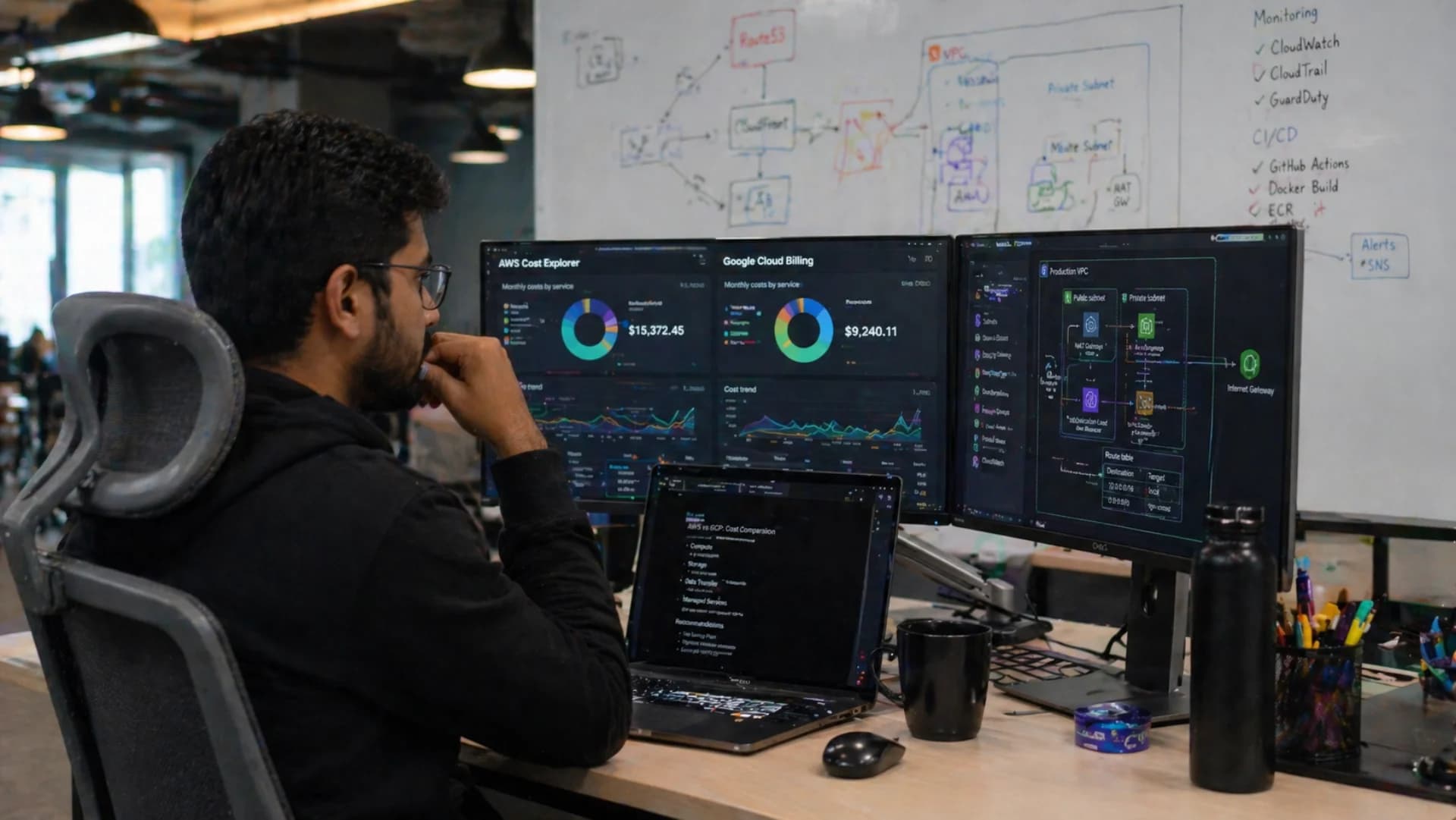
Is GCP cheaper than AWS in India? For compute, yes, by 10 to 20%. In October 2026 a 2 vCPU, 8 GB virtual machine in Mumbai costs $58.75 a month on Google Cloud (e2-standard-2, asia-south1) and $73.73 on AWS (m5.large, ap-south-1). That is a 20% gap like for like, and a 10% gap if you pick the cheaper burstable t3.large on AWS at $65.41. Storage is 8% cheaper on GCP. Bandwidth and serverless requests are cheaper on AWS. I have deployed on both for Codingclave clients since 2017, and this page gives you the current Mumbai prices in dollars and rupees so you can decide by workload instead of by brand.
Is GCP cheaper than AWS? The honest answer by workload
The short version, with October 2026 list prices for the Indian regions:
| Workload | AWS (Mumbai) | GCP (Mumbai) | Cheaper | By how much |
|---|---|---|---|---|
| 2 vCPU, 8 GB VM, general purpose | m5.large $73.73/mo | e2-standard-2 $58.75/mo | GCP | 20% |
| 2 vCPU, 8 GB VM, burstable | t3.large $65.41/mo | e2-standard-2 $58.75/mo | GCP | 10% |
| Object storage, standard class | S3 $0.025/GB | Cloud Storage $0.023/GB | GCP | 8% |
| Internet egress, first tier | $0.1093/GB (100 GB free) | $0.12/GB | AWS | 10% |
| Serverless requests | Lambda $0.20 per million | Cloud Run functions $0.40 per million | AWS | 50% |
| Automatic discount on the cheapest VM family | None (Savings Plans only) | None on E2 (committed use only) | Tie |
So "which is cheaper, GCP or AWS?" depends on what your bill is made of:
- Compute-heavy (APIs, app servers, databases on VMs): GCP, by 10 to 20%.
- Storage-heavy (backups, media archives, data lake): GCP, by about 8%.
- Bandwidth-heavy (video, large downloads, public CDN traffic): AWS, by about 10% on raw egress, more once CloudFront's India edge pricing is included.
- Serverless-heavy (event-driven, millions of small invocations): AWS, Lambda requests cost half.
- A typical SaaS bill (60 to 70% compute, 10% database, 10% storage, 10% egress): GCP, by 10 to 15% overall.
Sources: AWS EC2 on-demand prices for ap-south-1 and the AWS data transfer price list for Mumbai (pricing.us-east-1.amazonaws.com, October 2026); Google Compute Engine general-purpose pricing for asia-south1 (cloud.google.com, October 2026); S3 and Cloud Storage pricing pages. Monthly figures use the 730-hour month both providers use in their calculators.
GCP price in India (2026): compute, storage, egress in INR
Rupee figures below use Rs 93 to the dollar, roughly where USD/INR traded in the first week of October 2026. Google Cloud India and AWS India (Amazon Internet Services Private Limited) both invoice in INR at their own conversion rate and add 18% GST, which a GST-registered company claims back as input credit.
Compute (Mumbai, on-demand, Linux, 730 hours)
| Instance | Spec | GCP $/hr | GCP Rs/month | AWS equivalent | AWS $/hr | AWS Rs/month |
|---|---|---|---|---|---|---|
| e2-standard-2 | 2 vCPU, 8 GB | $0.0805 | Rs 5,460 | m5.large | $0.1010 | Rs 6,860 |
| e2-standard-2 | 2 vCPU, 8 GB | $0.0805 | Rs 5,460 | t3.large (burstable) | $0.0896 | Rs 6,080 |
| e2-standard-4 | 4 vCPU, 16 GB | $0.161 | Rs 10,930 | m5.xlarge | $0.202 | Rs 13,720 |
| e2-standard-8 | 8 vCPU, 32 GB | $0.322 | Rs 21,860 | m5.2xlarge | $0.404 | Rs 27,430 |
The e2-standard-2 rate is the same in Mumbai and Delhi. The 4 and 8 vCPU rows scale linearly from the published 2 vCPU rates, which is how both providers price within a family.
One correction to what I wrote in the first version of this post: GCP's sustained use discount does not apply to the E2 family. Google's documentation lists N1, N2, N2D, C2, M1 and M2 as the eligible families (20 to 30% off). E2 is already the cheapest option in Mumbai, so the $58.75 is the real month-end number. To cut it further you commit for one or three years, the same way you would buy an AWS Savings Plan.
Managed databases (2 vCPU, 8 GB, single zone)
| Database | AWS (RDS) | GCP (Cloud SQL) |
|---|---|---|
| PostgreSQL | about Rs 5,500/month | about Rs 4,800/month |
| MySQL | about Rs 5,500/month | about Rs 4,800/month |
| Managed NoSQL | DynamoDB (pay per request) | Firestore (pay per operation) |
These are the ranges I see on client bills in Mumbai for a small production database with 50 to 100 GB of SSD storage. High availability roughly doubles both.
Storage and bandwidth (Mumbai)
| Item | AWS | GCP |
|---|---|---|
| Object storage, standard, per GB-month | $0.025 (Rs 2.33) | $0.023 (Rs 2.14) |
| 1 TB stored for a month | Rs 2,330 | Rs 2,140 |
| Internet egress, first tier, per GB | $0.1093 (Rs 10.20), first 100 GB/month free | $0.12 (Rs 11.20), Premium Tier, first 1 TB |
| 1 TB served to the internet in a month | about Rs 9,200 | about Rs 11,200 |
Serverless
| Item | AWS Lambda | Google Cloud Run functions |
|---|---|---|
| Free requests per month | 1 million | 2 million |
| Price per million requests after that | $0.20 (about Rs 19) | $0.40 (about Rs 37) |
| Compute | per GB-second, slightly lower | per vCPU-second and GB-second, slightly higher |
Cloud Functions was folded into Cloud Run in 2024 and is now called Cloud Run functions; the pricing moved to the Cloud Run model.
Which is cheaper, GCP or AWS, for a real Indian SaaS bill?
Here is the stack I would put under a seed-stage B2B SaaS with 5,000 to 10,000 monthly users in India, priced in Mumbai:
| Component | AWS | GCP |
|---|---|---|
| 2 app servers (2 vCPU, 8 GB) | Rs 13,720 (2 x m5.large) | Rs 10,920 (2 x e2-standard-2) |
| Managed Postgres (2 vCPU, 8 GB) | Rs 5,500 | Rs 4,800 |
| 500 GB object storage | Rs 1,170 | Rs 1,070 |
| 500 GB egress | Rs 4,100 | Rs 5,600 |
| Load balancer, DNS, monitoring | Rs 3,000 | Rs 3,000 |
| Monthly total before GST | Rs 27,490 | Rs 25,390 |
GCP is about 8% cheaper on this bill. Push the egress to 2 TB and the gap closes to 2 to 3%. Drop the second app server and go serverless and AWS can come out ahead. That is why I do not trust any page that gives one percentage for "AWS vs GCP": the workload decides.
AWS vs Google Cloud India: quick comparison table
| Feature | AWS | Google Cloud (GCP) |
|---|---|---|
| Indian regions | Mumbai (ap-south-1), Hyderabad (ap-south-2) | Mumbai (asia-south1), Delhi (asia-south2) |
| Zones per Indian region | 3 | 3 |
| Number of services | 200+ | 150+ |
| Compute price, 2 vCPU/8 GB, Mumbai | $73.73/month | $58.75/month |
| Free offer for new accounts | $200 in credits, 6 months | $300 in credits, 90 days |
| Startup credits, ceiling | $100,000 (Portfolio), $300,000 (AI tier) | $200,000 (Scale), $350,000 (AI-first) |
| Discount model | Savings Plans, Reserved Instances, Spot | Committed use discounts, Spot VMs |
| INR billing with GST invoice | Yes (AISPL) | Yes (Google Cloud India) |
| UPI payment | Yes, including UPI AutoPay since Nov 2025 | Yes |
| Best for | Enterprise sales, widest catalogue, bandwidth-heavy apps | Data and AI, Kubernetes, lowest compute price |
Free tier in 2026: AWS $200 in credits vs GCP $300
This changed in 2025 and most comparison pages still have it wrong.
AWS (accounts created after 15 July 2025). The 12-month free tier is gone for new accounts. You get $100 in credits at sign-up and up to $100 more for completing activities such as launching an EC2 instance or using Bedrock. The free plan ends after six months or when the $200 runs out, whichever comes first (source: AWS What's New, July 2025). Accounts opened before that date stay on the old 12-month tier. A small set of always-free items remains, including 1 million Lambda requests a month and 25 GB of DynamoDB.
GCP. New accounts get $300 in credits valid for 90 days, usable in Indian regions. The always-free tier continues: one e2-micro VM (US regions only), 5 GB of Cloud Storage, 2 million Cloud Run functions requests, 1 GB of Firestore and 1 TB of BigQuery queries a month.
Winner: GCP's $300 is more money and its always-free list is longer. AWS's $200 is tighter but covers 200+ services. Neither is enough to run production for free beyond the first quarter.
Startup credits: AWS Activate vs Google for Startups Cloud Program
| AWS Activate | Google for Startups Cloud Program | |
|---|---|---|
| Self-serve tier | Founders: $1,000 plus $350 of support credits | Start: $2,000 |
| Funded tier | Portfolio: up to $100,000 via an Activate provider (VC, accelerator, incubator) | Scale: up to $200,000 over two years, Seed to Series A |
| AI tier | Up to $300,000 for foundation-model startups | Up to $350,000 for AI-first startups |
| Validity | 24 months | 24 months |
| Easiest route from India | Y Combinator, Sequoia Surge, Antler, 100X.VC, most Indian incubators are providers | Direct application with a funding proof |
Figures from each programme's own page, checked October 2026. Apply to both; they are not mutually exclusive, and $50,000 to $100,000 in combined credits covers 18 to 24 months of infrastructure for a seed-stage SaaS spending Rs 30,000 to Rs 50,000 a month.
When to choose AWS
1. Your buyers are Indian enterprises
Banks, insurers, PSUs and large corporates usually have AWS on their approved vendor list already. Being on AWS removes a procurement conversation.
2. You need an AWS-only service
Amazon Connect (contact centre), SageMaker (mature ML platform), IoT Core, Ground Station and Amazon Lex have no like-for-like GCP equivalent.
3. Your team already knows AWS
Certifications and two or more years of hands-on experience are worth more than a 10 to 20% compute saving in year one. Switching costs three to six months of slower delivery.
4. You push a lot of bandwidth
Egress from Mumbai is 10% cheaper on AWS, the first 100 GB a month is free, and CloudFront has deep edge coverage in India. For video, large downloads or a public CDN, this line item outgrows compute.
5. You are serverless-first
Lambda charges $0.20 per million requests against $0.40 on Cloud Run functions, and the AWS event ecosystem (SQS, EventBridge, Step Functions) is deeper.
When to choose Google Cloud
1. AI and machine learning are the product
Vertex AI hosts the Gemini models natively, BigQuery ML runs models on your warehouse without moving data, and TPUs give better price-performance than GPUs for training workloads that fit them. AWS Bedrock counters with a broader model menu (Claude, Llama, Mistral) inside AWS IAM.
2. Kubernetes is your runtime
GKE is the most mature managed Kubernetes service, and Autopilot bills per pod instead of per node, which removes a whole class of right-sizing work.
3. Analytics at scale
BigQuery handles terabyte-to-petabyte queries with no cluster to manage. For a data-heavy startup this alone can decide the question.
4. You want the lowest compute price without commitments
The e2 family gives the cheapest on-demand price in Mumbai with per-second billing and no reservation. Spot VMs cut 60 to 80% more for batch jobs.
5. Firebase for the mobile app
If you are building a mobile app, Firebase gives authentication, a realtime database, push, Crashlytics and remote config in one SDK with a generous free tier. AWS Amplify is the equivalent; Firebase's developer experience is better.
AWS alternatives in India: GCP, Azure, Oracle and Indian clouds
If you are searching for an AWS alternative in India, here is how the realistic options line up:
| Provider | Indian regions | Where it wins | Where it loses |
|---|---|---|---|
| Google Cloud | Mumbai, Delhi | 10 to 20% cheaper compute, data and AI tooling | Bandwidth price, enterprise procurement |
| Microsoft Azure | Pune (Central India), Chennai (South India), Mumbai (West India) | Microsoft 365 and Dynamics shops, enterprise compliance | Pricing is close to AWS, console complexity |
| Oracle Cloud | Mumbai, Hyderabad | Very cheap compute and egress, generous always-free tier | Small ecosystem, fewer managed services |
| DigitalOcean | Bangalore | Fixed monthly prices, simple | No deep managed services, single Indian region |
| Akamai Linode | Mumbai, Chennai | Predictable pricing, good network | Same limits as DigitalOcean |
| E2E Networks | Indian company, NSE-listed | INR billing, GPU rentals, Indian support hours | Much smaller catalogue |
My rule: GCP for a greenfield SaaS, Azure when the client is a Microsoft shop, DigitalOcean or Linode when the whole bill is under Rs 15,000 a month and you do not need managed queues or ML.
Architecture recommendations by stage
Early stage (0 to 1,000 users)
| Component | AWS | GCP |
|---|---|---|
| Compute | EC2 t3.small or Lambda | Cloud Run or e2-small |
| Database | RDS PostgreSQL | Cloud SQL PostgreSQL |
| Storage | S3 | Cloud Storage |
| CDN | CloudFront | Cloud CDN |
| Monthly cost | Rs 2,500 to Rs 6,000 | Rs 2,000 to Rs 5,000 |
Growth stage (1,000 to 50,000 users)
| Component | AWS | GCP |
|---|---|---|
| Compute | ECS Fargate or EC2 Auto Scaling | GKE Autopilot or Cloud Run |
| Database | RDS Multi-AZ | Cloud SQL HA |
| Cache | ElastiCache Redis | Memorystore Redis |
| Queue | SQS | Pub/Sub or Cloud Tasks |
| Monthly cost | Rs 20,000 to Rs 60,000 | Rs 17,000 to Rs 50,000 |
Scale stage (50,000+ users)
The provider matters less than the discipline. Buy committed use or Savings Plans for the steady base, run batch on Spot, and audit every quarter; most teams I review are paying for 20 to 40% of resources they no longer use.
Multi-cloud: should you use both?
For most Indian startups, no. Two clouds means two IAM models, two bills and two sets of on-call knowledge. The one split that pays for itself is GCP for BigQuery or Vertex AI alongside AWS for everything else, and only when the data or AI workload is large enough to justify the extra plumbing.
What changed in AWS vs GCP for India, 2025 to 2026
- AWS free tier became credits. Since 15 July 2025, new AWS accounts get $200 in credits over six months instead of the 12-month free tier.
- UPI AutoPay on AWS. AWS India added UPI payments in April 2024 and UPI AutoPay for recurring monthly bills in November 2025. Fewer failed international card charges, fewer suspended accounts.
- Bigger AI credits on both. Google for Startups now goes to $350,000 for AI-first startups; AWS Activate added a $300,000 AI tier.
- Cloud Functions became Cloud Run functions. Same code, Cloud Run pricing and features (concurrency, longer timeouts).
- E2 confirmed outside sustained use discounts. If your cost model assumed an automatic 30% off GCP compute, redo it; on E2 there is none.
- Cold starts are no longer the objection. Both Lambda (with SnapStart) and Cloud Run keep cold starts in the low hundreds of milliseconds for typical Node and Python services.
- RBI data localisation. Payment and sensitive financial data must stay in India. Both clouds comply with their two Indian regions each; what auditors ask for is proof of a tested failover and audit-ready logs.
Shorter answers: migration, Azure, bill predictability
Can I move from AWS to GCP later? Yes, but budget for it. A zero-downtime production database migration takes 4 to 12 weeks and the whole move costs Rs 15 lakh to Rs 1.5 crore depending on architecture. Do not migrate for a 10 to 15% saving alone; migrate when you need BigQuery or Vertex AI on one side, or Bedrock and SageMaker on the other.
AWS Bedrock or GCP Vertex AI for AI features? Bedrock for Claude inside AWS-native security, Vertex AI for Gemini. If you call models through a vendor API anyway, this does not decide your cloud; pick by the rest of the stack.
How predictable is the bill? AWS Cost Explorer and GCP Billing reports forecast the month within 5 to 10%. Set budget alerts at 50%, 75% and 100% from day one.
Is Azure worth a look? Yes if you sell to enterprises that run Microsoft 365 or Dynamics, or you want Pune and Chennai regions. Pricing is close to AWS, not to GCP.
My recommendation
- Choose GCP for a greenfield SaaS, an AI or data product, or anything where compute is the biggest line and you want the cheapest Mumbai price without a commitment.
- Choose AWS when you sell to Indian enterprises, your team already runs it, you are serverless-first, or bandwidth is your biggest cost.
- Either works for a standard web app or e-commerce platform; the 10 to 15% difference on the total bill is smaller than one bad instance-sizing decision.
At Codingclave I set up cloud infrastructure for clients on both AWS and GCP: service selection, cost estimates on each, CI/CD and monitoring. The estimate comes with the actual price list rows, not a percentage.
Related reading
- Custom Software Development Cost India
- Custom Software vs SaaS in 2026
- MVP Development Cost India 2026
- SaaS Billing India 2026: Stripe vs Razorpay
- Hire Offshore Developers from India
- Razorpay Integration
- OpenAI, Claude and Gemini Integrations
- Custom Software Development Services
Need help choosing AWS vs GCP for your project? Get a free infrastructure consultation: I will price your workload on both clouds using the current Mumbai rates and recommend one.
Or WhatsApp Ashish for a quick reply.
Get a Free Consultation | Cloud and DevOps Services | View Our Work
Last updated: 4 October 2026, with AWS and Google Cloud list prices for the Mumbai regions checked on that date. Written by Ashish Sharma, founder of Codingclave Development LLP, Lucknow (founded 2017, 200+ projects, 4.9 stars on Google from 76 reviews, Top Rated on Upwork).
Frequently asked questions
For compute, yes. In October 2026 a 2 vCPU, 8 GB VM in Mumbai costs $58.75 a month on GCP (e2-standard-2 in asia-south1) against $73.73 on AWS (m5.large in ap-south-1), which makes GCP about 20% cheaper like for like, and about 10% cheaper if you compare with the burstable t3.large at $65.41. Object storage is 8% cheaper on GCP ($0.023 vs $0.025 per GB). The answer flips on bandwidth and serverless: AWS charges $0.1093 per GB of internet egress from Mumbai against GCP's $0.12, and Lambda's $0.20 per million requests is half of Cloud Run functions' $0.40. For a typical Indian SaaS bill that is 60 to 70% compute, GCP ends up 10 to 15% cheaper overall.
Google lists the e2-standard-2 (2 vCPU, 8 GB) at $0.0805 per hour in both Mumbai (asia-south1) and Delhi (asia-south2), which is $58.75 for a 730-hour month, or about Rs 5,460 at Rs 93 to the dollar. The smaller e2-medium (2 shared vCPU, 4 GB) is roughly half that. Add a 30 GB balanced persistent disk at about $0.12 per GB-month ($3.60) and a static IP, and a single small production server lands between Rs 6,000 and Rs 6,500 a month before GST. Indian billing accounts are invoiced in INR by Google Cloud India with 18% GST, which you can claim back as input credit if you add your GSTIN. Prices from cloud.google.com/compute/pricing, checked 4 October 2026.
Storage: GCP. Cloud Storage Standard in asia-south1 is $0.023 per GB-month, S3 Standard in ap-south-1 is $0.025, so GCP is 8% cheaper and the gap is the same on 1 TB (Rs 2,140 vs Rs 2,330). Bandwidth: AWS. Internet egress from Mumbai is $0.1093 per GB on AWS for the first 10 TB (after 100 GB free each month) against $0.12 per GB on GCP Premium Tier for the first TB, so AWS is about 10% cheaper on outbound data. If you serve video or large downloads, egress will be a bigger line than compute and AWS plus CloudFront usually wins. If you store a lot and serve little, GCP wins. Both figures are from the providers' own price lists as of October 2026.
Google Cloud is the closest alternative with Indian regions in Mumbai and Delhi and 10 to 20% lower compute prices. Microsoft Azure has three Indian regions (Pune, Chennai, Mumbai) and is the default where a client already runs on Microsoft 365 or Dynamics. Oracle Cloud has Mumbai and Hyderabad regions and aggressive compute and egress pricing, but a much smaller ecosystem. For simple workloads, DigitalOcean (Bangalore) and Akamai Linode (Mumbai, Chennai) give fixed monthly prices with no egress surprises. E2E Networks is an Indian, NSE-listed cloud with a GPU focus and INR billing. I pick GCP for greenfield SaaS, Azure for enterprise Microsoft shops, and DigitalOcean for anything under Rs 15,000 a month that does not need managed services.
Only on older machine families. Google's sustained use discount documentation lists N1, N2, N2D, C2, M1, M2 and sole-tenant nodes as eligible, with a maximum of 30% off for N1 and M-series and 20% for N2, N2D and C2. The E2 family that most startups use (and that gives the cheapest price in Mumbai) is not eligible, so the $58.75 e2-standard-2 figure is the real month-end price with no further automatic discount. To go lower on E2 you need a 1-year or 3-year committed use discount, which works like an AWS Savings Plan. Spot VMs on either cloud cut 60 to 80% off for batch jobs that can be interrupted.
Mumbai (ap-south-1) by default. It has the widest service coverage, every new AWS service lands there first, and it has three availability zones for high availability. Choose Hyderabad (ap-south-2, opened 2022) only if your users are concentrated in South India and you can measure a 20 to 30 ms latency win, or if you need a second Indian region for disaster recovery and RBI audit requirements. Hyderabad still has gaps: some Bedrock models and newer ML services are Mumbai-only. For most Indian SaaS products under 100,000 users, single-region Mumbai is enough. Multi-region (Mumbai primary, Hyderabad DR) is worth it for fintech, healthtech and any workload that has to show RBI or DPDP auditors a tested failover.
Use Mumbai (asia-south1) by default. It has full service parity, including Vertex AI, BigQuery and GKE Autopilot, three zones, and the same e2 prices as Delhi ($0.0805 per hour for e2-standard-2). Pick Delhi (asia-south2) if your users skew North India (NCR, Punjab, UP) where it cuts 15 to 25 ms of latency, or when you need a second Indian region for failover. Delhi launched in 2021 with a smaller service catalogue and some SKUs still arrive later. For RBI-regulated fintech, a Mumbai primary with Cloud SQL read replicas in Delhi gives disaster recovery and lower latency for North Indian users in one move. Most startups can stay single-region Mumbai until cloud spend crosses Rs 5 lakh a month.
GCP gives more. The Google for Startups Cloud Program pays $2,000 for pre-seed founders and up to $200,000 over two years for funded startups, rising to $350,000 for AI-first companies. AWS Activate pays $1,000 in its Founders tier and up to $100,000 in the Portfolio tier, and up to $300,000 in a separate AI tier for foundation-model builders. AWS credits are easier to get approved in India because more accelerators and VCs (Y Combinator, Sequoia Surge, Antler, 100X.VC and most AWS-approved incubators) are Activate providers. Both last 24 months and the programmes are not exclusive, so apply to both. Figures from each programme's page, checked October 2026.
Yes. AWS India (billed by Amazon Internet Services Private Limited in INR) added UPI as a payment method in April 2024 and UPI AutoPay for monthly bills in November 2025, alongside net banking, RuPay and international cards. Google Cloud India also bills in INR and takes UPI, cards and net banking. One catch on both: RBI rules cap automatic debits without a fresh authentication, so bills above the mandate limit need a manual UPI or net-banking payment, or invoiced billing once your spend is large enough. INR billing removes the 3 to 4% forex markup on USD invoices, and the 18% GST on the invoice comes back as input credit for a GST-registered company.
Five cases. One, you sell to Indian banks, insurers, government or large corporates where AWS is already an approved vendor and GCP would add a procurement cycle. Two, your team has AWS certifications and two or more years on it; the GCP learning curve costs three to six months of slower shipping. Three, you need an AWS-only service such as Amazon Connect, SageMaker or IoT Core. Four, you push a lot of bandwidth: AWS egress from Mumbai is 10% cheaper and CloudFront is mature in India. Five, you are serverless-heavy: Lambda requests cost half of Cloud Run functions. The 10 to 20% compute premium is worth paying when two or more of these apply. For a greenfield SaaS with none of them, GCP is the better default.